
The Thursday Doors Writing Challenge 2026
is over, but I’m still writing the occasional
story for any image that catches my fancy …
and hopefully yours! Today’s story is inspired
by an image by David Booth. Many thanks to
Dan Antion for making these images available.
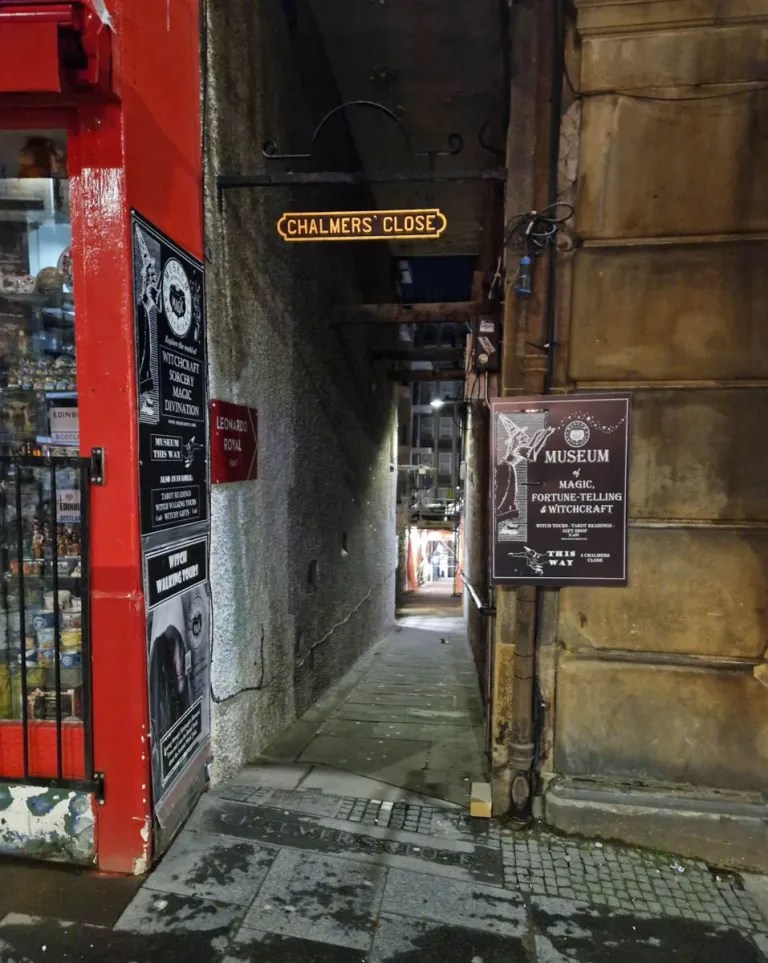
The sign on the corner read MUSEUM OF MAGIC, FORTUNE-TELLING & WITCHCRAFT, and beneath it, smaller: 3 Chalmers Close. This way.
Elsie had walked the Royal Mile in Edinburgh a thousand times and never noticed the close existed. That was the thing about these old passages …. they only appeared when you were looking for something, and vanished the moment you stopped.
She wasn’t looking for anything. She told herself that twice.
The neon sign halfway down buzzed her forward; CHALMERS’ CLOSE, lit orange against centuries of soot-blackened stone. The walls pressed close enough to touch with both hands. Somewhere below, a single window glowed amber, and she could hear, faintly, the sound of something being swept. A broom against stone, slow and rhythmic.
The museum door was propped open. No one was at the desk.
Elsie didn’t notice the tiny lead figure at first, the one with a face like hers; it was just an item in the case among dozens of others, each pierced through with a rusted pin. The placard read: Poppet, recovered 1968, Chalmers Close excavation. Maker unknown.
No name. No date. The others all had dates.
She leaned closer. The pin went through where the heart would be, and the face …. small, crude, weathered …. had her nose, her chin, the little furrow between the brows she’d had since she was a child.
“Most people don’t see it,” the woman said. She’d appeared without sound, the way the museum’s air seemed to swallow footsteps. “The resemblance. It only shows itself to certain visitors.”
“That’s not…..” Elsie’s voice came out smaller than she intended. “That’s not possible. It’s centuries old.”
“Edinburgh burned two hundred women on the Mile and the hills around it. More than anywhere else in the country.” The woman’s tone stayed pleasant, almost bored, a tour-guide cadence worn smooth by repetition. “Confessions extracted with the pilliwinks, the boot, weeks without sleep until the accused said whatever would end it. Most were strangled first, as a mercy, before they burned. Most.”
“Why are you telling me this?”
“Because the ones who weren’t shown mercy …. the ones burned alive, screaming what they swore were curses …. those curses needed somewhere to go.” She tapped the glass, once, beside the poppet’s pinned chest. “A name, a face, something to anchor to, until a real face came along that matched.”
Outside, the close had gone fully dark. The neon sign, the one that had drawn her down here, no longer buzzed.
“You should know,” the woman added, almost kindly, “it doesn’t usually take long. Once it’s found what it’s looking for.”
Behind the glass, the poppet’s pinned face was tilted now …. toward Elsie. It hadn’t been a moment ago.
The shop door, she realized, had no handle on the inside.
NAR©2026
Nancy’s Notes: This building is on Edinburgh’s Royal Mile, and it’s got real history. The close was named after Patrick Chalmers, a belt maker and Captain of the Trained Bands, and before that it went by several other names. Most strikingly, it leads down to the Trinity Apse …. the only surviving fragment of Trinity College Church, originally founded in 1460, which got dismantled when Waverley Station was built and then partially reassembled here. There’s also a real witchcraft museum on the close.
This is “Blood of Scotland’s Witches” by PsychWitch
Everything on The Elephant’s Trunk was created by me, unless otherwise indicated. Thank you for your consideration. NAR©2017-present.



That’s so creepy.
LikeLiked by 1 person
Thanks, Iris! I’m glad you enjoyed it.
LikeLiked by 1 person
Under duress and torture, Lady Jane Douglas’ servants and young son gave false testimony, leading to her conviction for treason which was followed by her being burned alive in Edinburgh Castle on July 17, 1537.
LikeLiked by 1 person
Just one of the many horror stories to come from that era. Thanks for the info, Jim.
LikeLiked by 1 person
Whew! That was a scary one! Loved it.
LikeLiked by 1 person
Ooh! So glad it landed well! Thanks!
LikeLiked by 1 person
Seriously terrifying, Nancy!
LikeLiked by 1 person
Ooh, thanks Liz! 🙀
LikeLiked by 1 person
An absolutely enthralling mythical story, and now I’ve read it all the way through, could you please let me out now …
LikeLiked by 1 person
Haha! Oh that was a wonderfully edgy song/video by the Waterboys, my friend. I’d heard it before but it had gone out of my head. It’s now part of my playlist. Thank you, dear Ivor! 🎶💙
LikeLiked by 1 person
Yes, it suited your article superbly , Nancy 🎶💙🌏📘🥰
LikeLiked by 1 person