
Inspired by Max’s blog, ‘Old Steam Ships’:
SS Columbia – The Ship That Proved Edison Right.
This week I have chosen not to focus on the tragedy
surrounding the Columbia. Rather, this is a fictional
dramatization in what might have been the voice of
Emperor Dom Pedro II of Brazil when he saw the
electric lights installed on the Columbia.
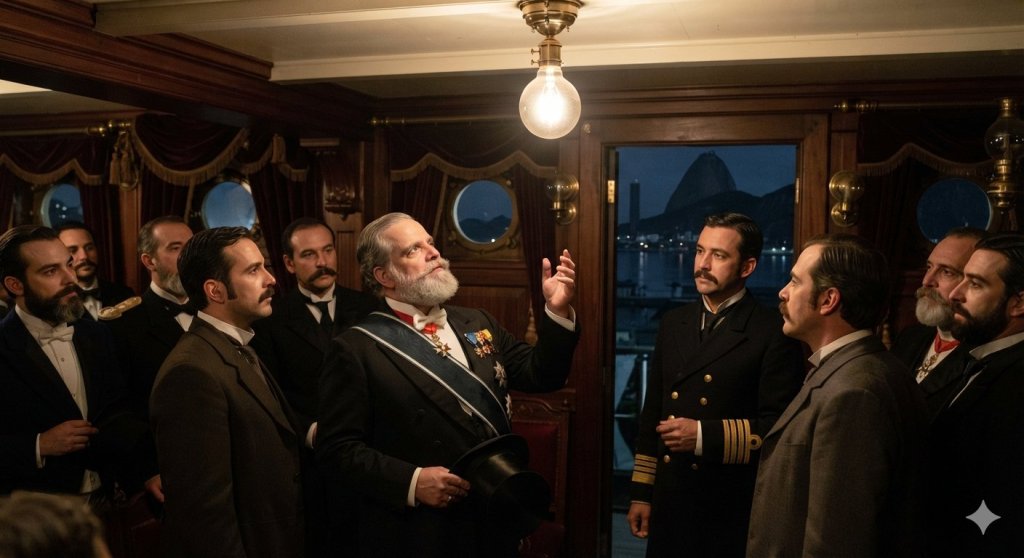
in the Port of Rio de Janeiro, Brazil, 1880
Image by Me & Nano Banana
Port of Rio de Janeiro, 1880
The heavy scent of whale oil and coal dust has long defined the nights of my empire, but tonight, floating in the dark waters of Rio, I have seen the dawn of a new century.
When the Columbia dropped anchor in our harbor, rumors preceded her like a herald. They spoke of a vessel that carried the very lightning of the heavens, tamed by the hands of that brilliant wizard of Menlo Park, Mr. Edison. I could not restrain my local curiosity. As a man who has dedicated his life to the advancement of science and the education of my people, I knew I had to see this marvel with my own eyes.
As my imperial barge neared the great steamer, the night seemed to fracture. There were no flickering, smoky gas jets or sputtering lamps lining her decks. Instead, a brilliant, steady, and ethereal glow spilled from her portholes, casting long, unyielding ribbons of white light across the black ripples of the bay. It was magnificent.
Stepping aboard, the captain welcomed me, but my eyes immediately strayed upward. Encased in delicate glass globes were small, burning loops of carbonized bamboo. I reached out, my fingers trembling slightly as I hovered them near the glass. There was no soot. There was no noxious odor. There was only a pure, constant illumination that refused to dance or die in the ocean breeze.
“Your Majesty,” the chief engineer explained, his voice filled with pride, “Mr. Edison’s men installed these themselves before we departed New York. Each lamp can be toggled in an instant.”
To prove his point, he turned a small brass switch. In a flash, a dark corner of the saloon was bathed in midday brilliance. I gasped aloud, entirely forgetting the rigid decorum expected of a monarch. I felt like a child witnessing magic for the very first time. For decades, I have sought to bring progress to Brazil …. funding railroads, stringing telegraph wires, and pushing our schools into the modern age. Yet, holding my hand beneath that incandescent bulb, I realized how much further we have to go.
Gaslight belongs to the past. This clean, breathless energy is the future. As I finally tore myself away and looked back at the darkened shores of Rio, silhouetted against the night, I made a silent vow. Brazil will not remain in the shadows of the old world. We, too, shall capture this light.
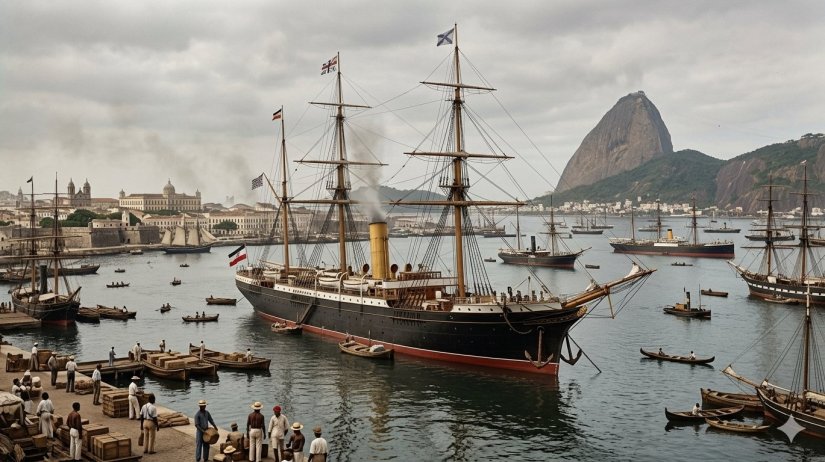
in the Port of Rio Janeiro, Brazil, 1880
Image by Me & Nano Banana
NAR©2026
The following video, SS Columbia: The Lost Light, offers photos and written descriptions; there is no audio.
This is “Aquarela do Brazil” by Ary Barroso
Everything on The Elephant’s Trunk was created by me, unless otherwise indicated, and may not be used without permission. Thanks for your consideration. NAR©2017-present.


Very cool story! History brought to life 👏
LikeLiked by 1 person
It was great being able to write something positive about this ship instead of focusing on its tragic sinking. Thanks, Lisa.
LikeLike
Wonderfully descriptive, Nancy, it was like I was looking on. As for Aquarela do Brazil, it had be bobbing up and down in my cair!
LikeLiked by 1 person
Oh dear, I’m having a bad spelling day today!
LikeLiked by 1 person
Haha! No judgement, my friend!
LikeLike
Thanks so much, dear Keith. This subject was fascinating for me. 💡
LikeLike
This was beautifully done. Oh, to witness those moments in time!
LikeLiked by 1 person
It must have been amazing, like us watching a moon landing. I’m happy you’re enjoying this series. Thanks so much!
LikeLike
I will encourage you to put tall your ghost ships stories together!
LikeLiked by 1 person
I’ve taken that to heart, my dear!
LikeLike
I loved your poetic description of the early light bulbs, Nancy. In 1879, Thomas Edison invented the commercially viable incandescent light bulb. Edison tested a carbonized cotton thread in late 1879 (which burned for about 13.5 hours), throughout 1880 his laboratory tested thousands of different materials. This exhaustive search led him to discover that carbonized bamboo fibers, particularly Japanese bamboo from the town of Hachiman were found to be remarkably durable and flexible, extending the lifespan of his bulbs to over 1,000 hours. General Electric (GE) was created in 1892 by a merger engineered by J.P. Morgan between Edison General Electric and its main competitor, Thomson-Houston Electric Company, establishing the General Electric Company. Edison sold his financial interest in GE in 1893, and they introduced tungsten-filament lamps commercially around 1906 to 1911, while Edison focused on other ventures.
LikeLike
Thanks so much for these interesting and informative comments, Jim. I love history and reading about these great inventors and pioneers of technology. Fabulous research on your part, as usual.
LikeLiked by 1 person
As an electrical engineer, I know a little bit about electricity and when I was living in New Jersey the bordering town was Edison and I drove through Menlo Park many times.
LikeLiked by 1 person
Very cool! I thought we were going to lose our electricity today as we are in the middle of a nor’easter. So far so good!
LikeLiked by 1 person
I have been watching that storm on the news, but I have absolutely perfect weather here in Florida.
LikeLiked by 1 person
Thank you, Nancy! The reason I say that is because you concentrated on the electricity. It was a huge leap for society when this happened. It helped popularize electricity. You wouldn’t think it wouldn’t need it but with every new invention there are skeptics. What a magical moment for these people at the time. I never thought of what you said…no more scent of oil and no more soot…a cleaner environment. You brought that feeling with your post.
LikeLiked by 1 person
Max, I’m so glad there was more to this story which gave me something to focus on rather than tragedy and the sinking. In my research, I learned that Emperor Pedro II of Brazil was a modest, highly intellectual, and dutiful ruler who preferred the life of a scholar to the luxuries of a monarch. He was a lifelong learner who spoke multiple languages, loved science and philosophy, and corresponded with the great thinkers of his day like Darwin and Edison. It was a real pleasure to write this story and I’m happy you enjoyed it. Thanks!
LikeLiked by 1 person
I no clue about him. I did read where they were visited but I never knew that about him. You rounded out the story perfectly…you gave it another side which is great. Now people may remember this ship and the people she affected.
LikeLiked by 1 person
I hope so, Max, instead of only remembering only the tragic events. Thanks very much.
LikeLiked by 1 person
This is a great story and describing it you , as always brought my imagination to life. Bark Bark!
LikeLiked by 1 person
Thanks so much, Ernie! I’m really happy knowing you are enjoying this series. Woof woof! 😀
LikeLiked by 1 person
I love how you brought this piece of history to life and a great musical version of that rousing song 🙌
LikeLiked by 1 person
One of my faves, Ange! Thanks for your comments and for enjoying this series. ☺️
LikeLiked by 1 person
🩷
LikeLiked by 1 person
Nicely done sis
LikeLiked by 1 person
Thanks very much, dear sis 🥰
LikeLiked by 1 person
You’re most welcome
LikeLiked by 1 person