Inspired by Max’s blog, ‘Old Steam Ships’ –
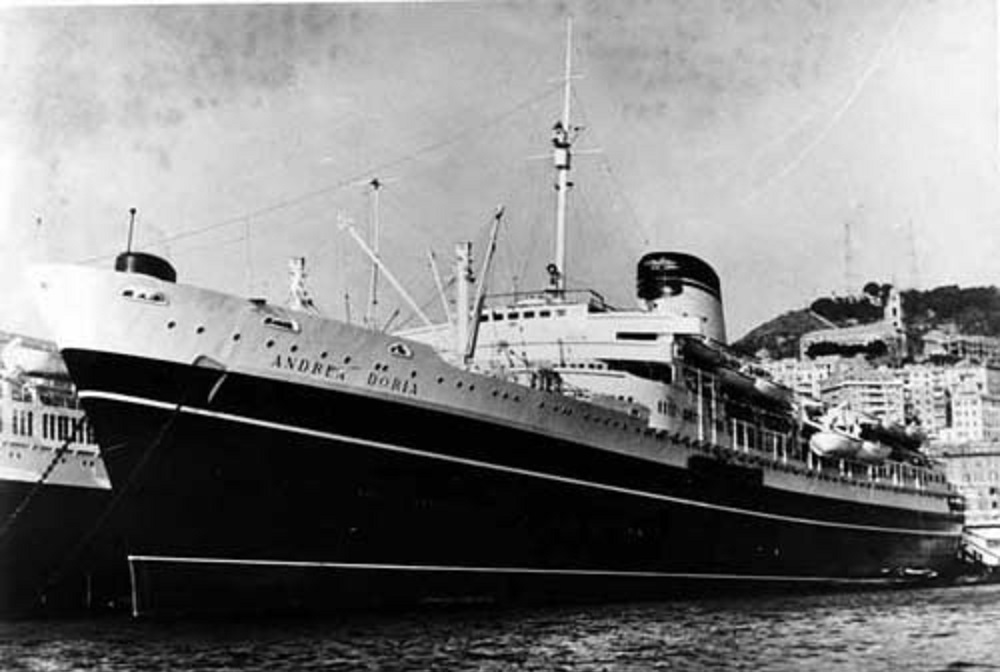
SS Andrea Doria: The Last Great Ocean
Liner Disaster. This one is personal;
this is the story of my father,
what he felt in his heart and
what he would have said.
I. Wednesday Night – July 25, 1956
It was half past 10:00, and The Bronx was doing what The Bronx did on a hot July night …. stoop conversations drifting up through open windows, somebody’s Sinatra record skipping two houses down, the smell of fresh basil on a windowsill. Vito sat at the kitchen table in his undershirt with a glass of red wine he’d cut with water the way his father used to, and across from him his wife Connie was folding towels she didn’t need to fold.
The eleven o’clock news came on. Vito always listened, out of habit more than hunger for headlines. The announcer’s voice changed register in a way Vito recognized from the war. Not panic. Something more careful than panic …. a man choosing his words because he did not yet know how bad the thing he was describing might turn out to be.
“We interrupt this broadcast with word of a maritime collision off the coast of Nantucket. The Italian luxury liner Andrea Doria, en route from Genoa to New York, has reportedly collided with a Swedish vessel in dense fog. Details are still coming in. The Doria was due to dock in New York tomorrow morning.”
Connie’s hands went still on the towel.
Vito set down his wine.
“The Doria,” he said, and it came out strange, half a question, as if saying the name again might change what he’d just heard.
He knew the ship the way every Italian in New York knew it …. not personally, but as a kind of family pride you carried without ever having met the relative in question. The Andrea Doria was Italy’s answer to a decade of humiliation. She had launched in 1951, six years after the war had left Italy’s cities in rubble and her merchant fleet at the bottom of the Mediterranean, and she was the most beautiful ship Italy had ever built …. three outdoor swimming pools, murals by the finest artists in Genoa, a first-class dining room paneled like something out of a fairy tale. She flew the Italian flag into New York Harbor eight times a year and every time she did, it was as if Italy herself were walking tall again after being made to crawl. Vito had gone down to the pier once, two years back, just to see her come in. He had stood in the crowd with strangers and felt his chest fill up the way it used to when the anthem played.
II. Thursday – July 26, 1956
Nobody in the house slept well that night, and by six in the morning Vito had already walked to the corner for the Daily News and the Herald Tribune both, which was an extravagance.
LINER RAMMED IN FOG; ANDREA DORIA LISTING BADLY OFF NANTUCKET — RESCUE UNDERWAY
He read it standing on the stoop; Angela came out in her housecoat and read it over his shoulder, and neither of them said anything for a long moment because there was a photograph …. grainy, taken from another vessel at first light …. of the great liner heeled over on her side like something wounded and trying not to show it.
The details, as they emerged through the day on the radio and later on the small television set Vito had bought the year before, mostly for his daughters, were almost unbearable in their detail. A Swedish ship, the Stockholm, fortified to cut through ice, built for North Atlantic crossings, had struck the Doria’s starboard side in fog so thick neither captain had seen the other until it was too late to matter. The Doria had taken the blow low, near her fuel tanks; she’d flooded unevenly and listed nearly thirty degrees within minutes, so severely that half her lifeboats hung uselessly in the air, un-usable, while the boats on the opposite side dangled just above black water.
Vito went to work that morning but he could not have told you, at the end of the day, how many men sat in his barber’s chair or who they were. He kept the transistor radio on all day and every man in the shop, Italian or not, gathered round it because the story had become, in the space of a single morning, everyone’s story.
By afternoon the shape of a miracle appeared. The Ile de France, the great French liner, had been hours away on her own crossing and had turned back …. turned around in the open Atlantic and steamed toward the stricken Doria to take on survivors. Coast Guard cutters were converging. A U.S. Navy transport, the Cape Ann, and a tanker, the Robert E. Hopkins, joined in. Because the Doria was going down slowly …. eleven hours, someone on the radio said …. nearly everyone aboard had a chance that the Titanic‘s passengers had not.
“Eleven-hundred people,” Vito said to Connie that evening, sitting at the table with his dinner going cold in front of him, the little television flickering black-and-white footage of the Ile de France lit up like a Christmas tree in the black ocean night. “Eleven-hundred people and they are getting almost all of them off. Almost all.“
He said it the way a man says a prayer he isn’t sure has been answered yet.
Rosemarie, his nine-year-old daughter sat cross-legged on the floor, closer to the television than she was allowed, and asked the question a nine-year-old asks. “Papa, is it a bad ship? Did Italy build a bad ship?”
Something in Vito’s face changed so fast that Connie put a hand on his arm before he’d even opened his mouth.
“No,” he said, and his voice had the certain steadiness he used when he was trying to control his anger. “No, cara. Listen to me. That is the finest ship my country ever built. She is dying slow because Italian engineers built her to die slow, so that everyone aboard her would have time to live. You understand? Don’t let anybody tell you different …. not about the Doria, and not about where we come from.”
Rosemarie nodded slowly, the way children nod when they understand that the answer mattered.
Later, after the girls were in bed, Connie found Vito on the stoop with a cigarette he wasn’t really smoking, just holding, watching it burn down between his fingers.
“You’re not angry at the ship,” she said. “You’re angry at something else.”
“I’m angry,” he said slowly, “that a Swedish captain runs his ship at full speed through fog because he is behind schedule, and an Italian captain does everything right, and it is my country’s ship at the bottom of the ocean tomorrow morning and my country that has to explain herself to every newspaper in this city.” He drew deeply on the cigarette. “You know what I heard a man say on the subway platform tonight? Coming home. He didn’t know I understood him, or didn’t care. He said, ‘Guinea ship, guinea captain, what do you expect.'”
Connie went still.
“I turned around,” Vito went on, quiet now, dangerous-quiet, “and I said to him, in English good as his own, that I put on an American uniform in 1943 and walked through fields in Sicily with German artillery falling around me so that men like him could stand on a subway platform and say ignorant things in safety. I told him the captain of that ship stayed aboard her past the last lifeboat, would not leave his ship while a single soul remained on her, and that is not a guinea captain, that is a man, and men like that built the country I come from same as they built the one I live in now.”
“What did he do?”
“He got off at the next stop.” A short, humorless laugh.
Angela sat beside him on the step and put her head against his shoulder, and for a while neither of them said anything, and the street noise went on the way it always did. And somewhere out past Nantucket a ship that had carried a nation’s pride across the Atlantic eight times a year sat dying in the dark with lights still burning on her upper decks, waiting for the water to finish what the fog and the Stockholm had started.
III. Friday – July 27, 1956
She went down at 10:09 in the morning. Vito sat in front of the television with Connie and the girls, the shop closed for the morning as if it were a holy day, which in a way it was. The new footage came in jerky and delayed, the way live television did in those days …. the Doria’s three red-and-white funnels finally slipping under, the great hull rolling onto its side and vanishing, a boil of white water where twenty-nine thousand tons of the pride of the Italian Line had been afloat a moment before.
Forty-six people, they would learn in the coming days, had died …. most of them in the terrible first minutes of the collision itself, crushed in cabins the Stockholm‘s reinforced bow had opened like a can. Out of more than seventeen hundred souls between both ships, the rescue fleet …. Italian sailors and Swedish sailors and French sailors and American Coast Guardsmen, working through a black Atlantic night …. had saved all but those forty-six. It was, by any honest measure, one of the great rescues in the history of the sea.
Vito wept … and this time he did not try to hide it from his children.
“Papa.” His five-year-old climbed into his lap with the perfect radar small children have for a grown-up in pain. “Why are you sad? You said the ship was good. You said they saved everybody.”
“Almost everybody, cara mia,” Vito said, and kissed the top of her head. “And that is why I am crying. Because when something you love is hurt very badly, and most of it survives anyway …. because good people ran toward the danger instead of away from it …. that is not only sadness. That is pride, so big it comes out of the eyes instead of staying in the chest.”
He held both his daughters that morning and he told them …. not for the first time, and not for the last …. about his home town in Sicily, about the lemon groves, about their grandparents, about a country that had been broken almost in half by war and had built a ship so proud and so well-made that she had died with nearly everyone aboard her alive to tell the story.
“That is what it means to be Italian,” he told them. “Not the food, not the songs, though God knows we have the best of both. It means when the world knocks you down, you build something beautiful anyway. Don’t let anybody in this country, this beautiful country I love as much as I love the one I was born in, don’t let anybody tell you that is a small thing to be proud of.”
That evening, after the girls were asleep, Vito sat on the stoop; Connie watched from the kitchen window, giving him some time alone. The July heat was starting to break at last into something like an ocean breeze, and he sat for a long moment looking east, past The Bronx’s dark rooftops toward the Atlantic and the two shores he loved beyond measure.
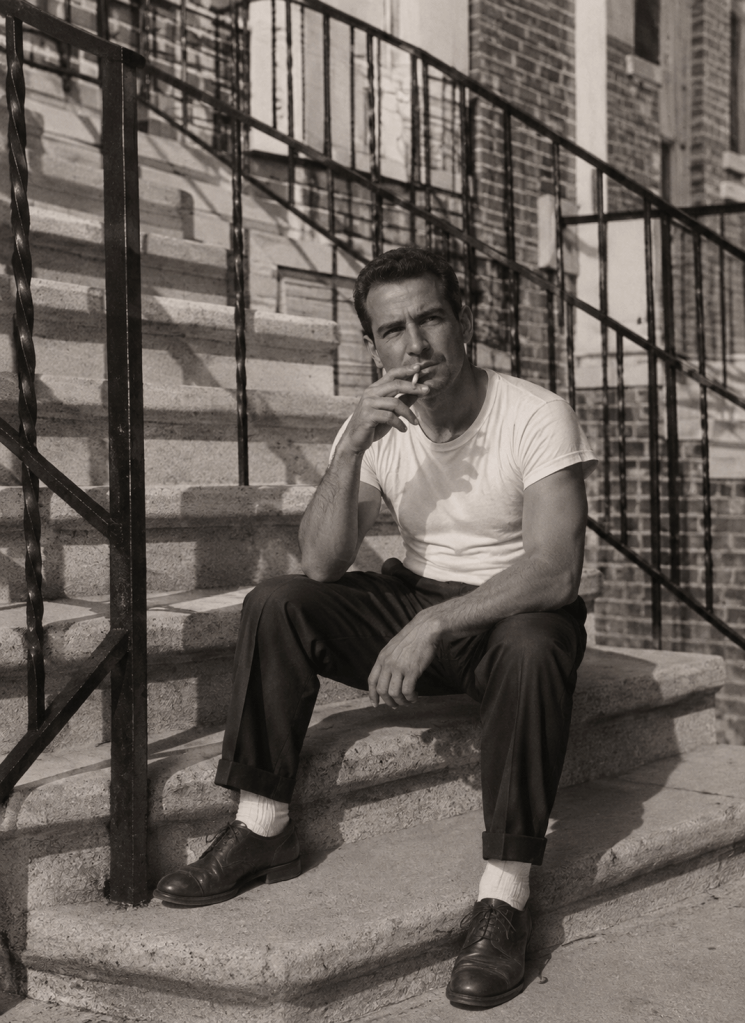
Image by Me & ChatGPT
NAR©2026
This is “SS Andrea Doria – Videoclip” by X-MarcosNavigator Music
Everything on The Elephant’s Trunk was created by me, unless otherwise indicated, and may not be used without permission. Thanks for your consideration. NAR©2017-present.


A very moving and heartfelt story sis. Thank you for sharing
LikeLiked by 1 person
My great pleasure and honor to add a personal touch to these tragic stories. Thank you very much, dear sis. 🥰
LikeLiked by 1 person
You’re most welcome dear sis
LikeLiked by 1 person
This is so wonderfully told Nance – you as that little girl really – oblivious to what was happening but somehow still absorbing the feelings. Your dad would be – and I’m sure is, so very proud of la sua bambina 💕🩷💕
LikeLiked by 1 person
Thanks for your lovely and encouraging comments, Ange, which mean so much to me. I don’t have a lot of many memories of my dad from that stage of my life but the times I do recall are profound and steeped in the history of Italy, pride of our heritage, and love of family. My dad passed almost 30 years ago but we still share stories about our Papa. ❤️
LikeLiked by 1 person
🩷💕🩷
LikeLiked by 1 person
I’ve been sitting here reflecting on your story for quite a while. A tragic tale that drew me in. If only your father could read it.
LikeLiked by 1 person
I had those very same thoughts, dear Keith. Thank you for a lovely comment; you warmed my heart. 😊
LikeLike
A beautiful emotional turn here—especially the idea that pride can be so overwhelming it has nowhere to go but through the eyes. Vito isn’t just mourning a ship; he’s passing a piece of Sicily, resilience, and identity to his daughters. Beautifully done.
LikeLiked by 1 person
Thank you Patricia. My father would be delighted with your comments. I certainly appreciate them.
LikeLiked by 1 person
I am guessing that you were the five-year-old who climbed into your father’s lap Nancy. Italians are famously passionate about their heritage, and this immense cultural pride is rooted in centuries of global influence.
LikeLiked by 1 person
Yes, I was the younger daughter; my sister Rosemarie is 4 years older than me, to the day. You’re right about our passion and pride; they are powerful emotions we don’t try to hide. My father could be a volatile man, but never dangerous or abusive. My mother was the level-headed one in the family. Just like most people from that era, particularly immigrants, my parents had more than their share of hardships but they managed to hold things together and persevere. My sister and I were given the best life possible with a good education, a roof, food, and clothes, and a religious upbringing that was an important part in our lives. I’m very grateful to my parents for all their sacrifices and for teaching us well. Thanks, Jim.
LikeLiked by 1 person
I have to say…the most moving and the best one yet. It got me emotional and of course I wasn’t even there. You took the history inside a home and showed what it meant to people like your dad. Its almost like a script and a story combined because I could see everything in my head perfectly like a movie. Also…you summed up the entire story of her in one beautiful sentence: “When the world knocks you down, you build something beautiful anyway.” Wonderful Nancy…again your story complimented mine and made it better because you showed the emotional side of it. Something I couldn’t have guessed. Thank you!
LikeLiked by 1 person
Thanks so much, Max …. not only for your wonderfully warm comments but for giving me the opportunity to write the personal/emotional side of a topic with which we are both fascinated. I know this one would make my father quite proud of his little girl! Keep the ships coming, Max, and I’ll write a story. See you next time on board Old Steam Ships. 🛳️
LikeLiked by 1 person
The pleasure is all mine. I really think we complement each other well in this. I try to stay out of the emotional part (I’m not always successful in that) which is very hard for me because that is how I write my music posts…on how I feel…but with these I try my best to be neutral. You give an emotional side which completes the picture.
In this one you nailed it again. Yes…see you aboard for the long weekend!
LikeLiked by 1 person
Can you imagine the pressure I’m under right now knowing what’s coming up soon? 😉
LikeLiked by 1 person
LOL…loads! In reality…I don’t see how you do that turnaround in such a small amount of time.
LikeLiked by 1 person
That really puts a different perspective on how I view this event. Things you don’t think of unless you have a person connection. Love that photo.
LikeLiked by 1 person
Thank you. I’m very pleased you appreciated my story and enjoyed the photo.
LikeLiked by 1 person
What an amazing story and you certainly gave it the most personal of touches. This is your best and most moving ship tragedy story. ❤️
LikeLiked by 1 person
Oh, thanks for these beautiful words, my sister. You’ve touched my heart. ❤️
LikeLiked by 1 person
🩷💕🩷
LikeLiked by 1 person
A very sad and heartfelt story, and so eloquently narrated my dear friend 🥰🌏🚢😘
LikeLiked by 1 person
What an emotional video this is, my dear friend. Thanks for the soundtracking and thank you for your beautiful comments. My father would be very proud of me. 💙🥰🎶
LikeLiked by 1 person
Totally my musical pleasure, I searched YouTube for the a meaningful song for your very meaningful story and then I found this video and I said to myself, “Nancy will appreciate this one” 🥰🎶💕🌏📖
LikeLiked by 1 person
And you were right! I definitely did! Thank you dear friend. 🥰
LikeLiked by 1 person
A truly sad story …. thank goodness so many beers saved….making it extra hard though for the families of those who perished…. I love the way you personalised the story through Vito and his family.
The video was also very interesting…. it only confirms my fears of the sea and cruise ships … 💜💜💜
LikeLiked by 1 person
Thank you, Sis. My father was a good man and very proud. I know he would be pleased with this story and all my others. 💜
I’ve been on exactly one cruise. Even if I didn’t get seasick, I’ll never do it again.
LikeLike
Oh! course your dad would love everything you do 💜💜💜💜.
I have done ferries and River cruises but an ocean liner never no thank you 💜
LikeLiked by 1 person
I hear that, sis! And thanks for your lovely comments; I’m sure he would be. 💜
LikeLike
💜💜💜
LikeLiked by 1 person
Beautifully written, Nancy, a very moving tale.
LikeLiked by 1 person
Thanks so much, Clive. I’m so pleased you’re enjoying my steamship stories.
LikeLiked by 1 person
Max’s posts are great, and you add a new dimension to them. Very enjoyable all round.
LikeLiked by 1 person
☺️
LikeLiked by 1 person
It is dark out there off Nantucket, in the Atlantic, at night, even on good nights. In the fog . . . maybe without radar.
LikeLiked by 1 person
That’s a definite, Allen.
LikeLike