
Inspired by Max’s blog, ‘Old Steam Ships’ –
this is my dramatized first-person fiction
built around the documented history of
Kapitänleutnant Walther Schwieger,
commander of U-20 responsible for
the sinking of the RMS Lusitania.
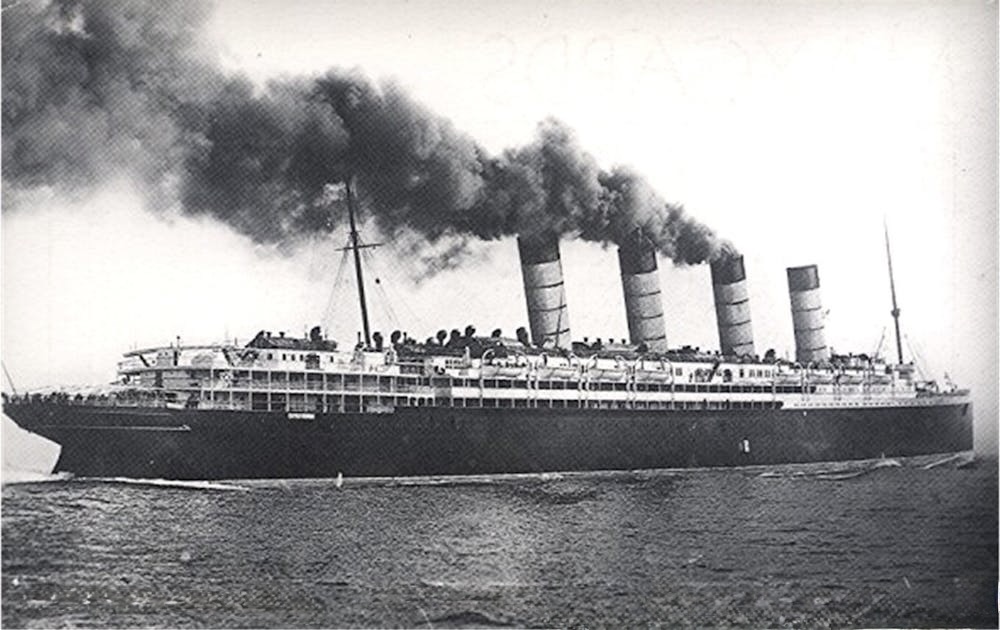
7 May 1915 – aboard U-20
The fog lifted late that morning, and with it came the sun …. thin, pale, but enough to make the sea glitter in a way that felt almost obscene given what the day would bring.
We had been running on the surface, low on fuel, low on torpedoes, contemplating a return to Emden. Three torpedoes remained. I had already turned us for home when the lookout’s voice cracked the silence: smoke, four stacks, coming up fast off the starboard bow.
Four funnels. I knew what that meant, or thought I did. The Admiralty had converted liners like this one before …. armed her, they said hidden guns behind false plating, turned passenger ships into hunters of U-boats. I had heard the briefings. I had read the intelligence reports, half-rumor, half-fact, delivered with the certainty of men who were not the ones who had to decide, in the space of a breath, if a ship was what it seemed.
I gave the order. One torpedo, no warning shot, no flag signal demanding she stop for inspection …. international law be damned, or so I told myself, because a Q-ship* does not wait for you to surface and ask politely before she opens her gun ports and sends you to the bottom. That was the doctrine. That was the fear I had been trained to carry, and I carried it like a stone in my chest every time a silhouette rose on the horizon.
The torpedo ran true. I watched through the scope as it struck her starboard side, aft of the bridge. A column of water, dirty white, then black smoke rolling up thick as a curtain.
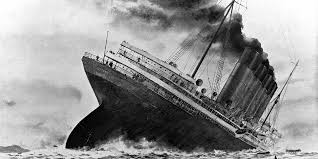
And then the second explosion.
I have turned this over more times than I can count since. It came from deep within her, a sound and a force far beyond what one torpedo should produce. Coal dust, some said later. Ammunition, said others …. that she was carrying more than passengers in her hold, that this was the proof we needed, the justification, the thing that would let me sleep. I do not know. I knew only that she was dying faster than any ship I had ever hit, listing hard to starboard within minutes, her decks already tilting toward the water.
That was when I understood what I had done.
Through the periscope I could see them …. not silhouettes now, not “targets,” not the facts and statistics that fill our patrol logs, but people. Boats being lowered and capsizing before they touched the water because she was listing too fast, too steep. Figures running, falling, jumping. Women. I saw women at that rail. I do not know if I truly saw children, or if my mind has placed them there in the years since, unable to let the memory rest as merely “civilian casualties,” a phrase so bloodless it might as well describe cargo.
© Britannica
I wrote in the log …. and I have read my own words back to myself since, searching for the man who wrote them, wondering if I recognize him:
It looks as if the ship will stay afloat only for a very short time. Dive to twenty-five metres and leave the area seawards. I couldn’t have fired another torpedo into this mass of humans desperately trying to save themselves.
I could not. Whatever else I was …. and I was a naval officer, sworn to a doctrine of unrestricted war, sworn to the belief that Britain’s blockade of our homeland starved German children as surely as any torpedo drowned English sailors …. I was not able to put a second fish into that wreckage of scrambling bodies. There are men who could have. I have met them. I was not one of them, not that day, whatever I had been in the weeks before.
We went deep and we went quiet and I listened, as we always listen, to the sounds of a dying ship transmitted through the water and beneath it, though perhaps this is a thing I have imagined in the retelling, I believed I could hear the sea swallowing something enormous and human all at once.
It was hours before the wireless confirmed what I already feared. Lusitania. Not an auxiliary cruiser after all, though she had been built to Admiralty specification, though she may …. I still believe this, I have always believed this …. have been carrying more in her hold than the manifest declared. It does not matter now. It did not matter then, not to the twelve hundred who did not come up out of that water.
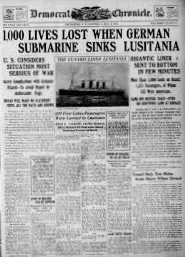
I am told Berlin will call this a victory. I am told the newspapers will print my photograph beside words like hero and triumph. I have read that London will call me a murderer, a beast, and will not be wrong to do so, whatever cause I told myself I served.
I gave the order in four seconds, the time it takes a torpedo officer to confirm bearing and fire. I have had four seconds to justify it and a hundred years, it feels, of afternoons like this one to live inside the four seconds after …. the ones where I looked through the scope and saw, too late to matter, exactly what I had done.
We surfaced that night to recharge batteries. Nobody on the boat spoke of it above what duty required. I do not think any of us had the words. I certainly did not, and I write in this log for want of anywhere else to put them.
NAR©2026
Nancy’s Notes: *Q-ships, also known as Q-boats, decoy vessels, specialized service ships, or mystery ships, were heavily armed merchant ships with concealed weaponry, designed to lure submarines into making surface attacks
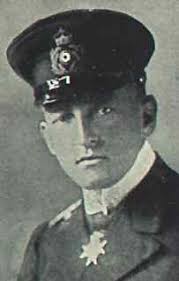
Walther Schwieger was born in 1885 and in 1903 at age 18, joined the Imperial German Navy. He chose the submarine service early; by 1912, he was appointed to command U-14 and was appointed to U-20 shortly after the outbreak of war. Allegedly, he had the reputation of shooting first and asking questions after. He was killed in U-88 on September 5, 1917, which probably hit a mine. During his wartime career, Schwieger captained three different submarines, on a total of 34 missions. He sank 49 ships and killed too many people to count.
This is “The Sinking of the Lusitania” by Sleeping Sun
Everything on The Elephant’s Trunk was created by me, unless otherwise indicated. Thanks for your consideration. NAR©2017-present.


This is awful/good, Nancy. I remember reading about the Lusitania in history class. You have to wonder how, if any, of those people lived with themselves.
LikeLiked by 2 people
Thank you, Lois. Judging by everything I read, the German U-boat commander carried a lot of guilt afterwards and wrote about it in his diary; still, he ordered attacks on dozens of ships in the remaining two years of his life. Great comment.
LikeLike
I liked your take on the Lusitania being the man in charge of firing the torpedo, Nancy.
LikeLiked by 1 person
Thanks, Jim. To me, it seemed the most logical and interesting approach. I’m glad you liked it.
LikeLiked by 1 person
This is SO good, Nancy!
LikeLiked by 1 person
Thank you very much, Keith. I’m glad to know you appreciated it.
LikeLiked by 1 person
Thank you, Nancy. I never saw that perspective coming! You made me believe he was thinking that…and by the quotes of him…he very well could have. Great story telling… I’ve read where he did have problems with what he did and that quote by him says it. Just a terrible event to happen regardless. Again Nancy thanks so much!
LikeLiked by 1 person
My great pleasure, Max, and I’m pleased you enjoyed the approach I took. I’m sure Schwieger carried an enormous burden afterward, even though he did what was expected of him. Just like you are drawn to writing about these ships, I am driven to tell their stories. Thanks for the opportunity.
LikeLiked by 1 person
Yes…people forget these are humans that don’t want to be where they are at on either side. Thanks again Nancy…that was excellent.
LikeLiked by 1 person
This is gripping! It is like you have channeled the Captain. Tragic and human.
LikeLiked by 1 person
Thank you, Lisa. The circumstances of these ships affect me greatly and I simply have to write about them. I’m delighted to know how much you appreciate my stories. 😊
LikeLike
A tragic loss of life – but war is one tragedy built on many. I really admire how you get inside the head of this U-boat captain Nance, it undoubtedly was a horrendous thing to he responsible for 💔
LikeLiked by 1 person
Thank you, Ange; fortunately the net provides immediate access to any info we need. The events surrounding these ships get into my soul. It’s an honor to write about them. Thanks for appreciating my work. ❤️
LikeLiked by 1 person
You do these tragic tales justice Nance 🩷
LikeLiked by 1 person
A magnificently compiled story of the tragic sinking/torpedoing of the ‘Lusitania’, superbly narrated my friend … 📃🥰🌏 … I think Bob Dylan’s lyrics in this great song, might reflect the thoughts of the ‘Commander’ …
LikeLiked by 1 person
Thanks so much, my dear friend. There’s something about these steam ships that’s so compelling; they speak to me and need to tell their story. I’m so pleased you appreciated this one. Wonderful song by Dylan. Great soundtrack. 🎶💙
LikeLiked by 1 person
Truly, very much my pleasure my dear friend 📖🥰
LikeLiked by 1 person
What a fascinating and creative approach! Blending documented history with first-person dramatized fiction makes the story feel immersive while honouring the historical context. Inspired work, and I look forward to reading more of your writing. Well done!
LikeLiked by 1 person
Thank you, Safia. I pleased to know you enjoyed my story.
LikeLike