Inspired by Max’s blog, ‘Old Steam Ships’ –
“RMS Mauretania: Queen of the Atlantic”.
Finally a steam ship story that isn’t tragic!
In Max’s post, he mentioned an un-named couple who spent their honeymoon on board the Mauretania on her maiden voyage in 1907. Nearly 28 years later they returned to say goodbye to the ship that helped begin their married life. I’ve named them Thomas and Mary Ashworth of Manchester, and let the story move between the stripped-down ship of 1935 and the new and gleaming one of 1907.
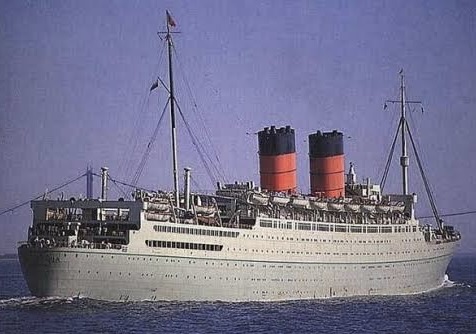
© Britannica
The Last Crossing: The Story of Thomas & Mary Ashworth
Southampton, 1 July 1935
“You’ve brought the hatbox,” Thomas said.
“I have.”
“We are going to Scotland, Mary. To watch a ship be taken apart. Not for an audience with the Queen.”
Mary Ashworth adjusted her gloves. “I wore this hat on the maiden voyage, and I shall wear it on the last. If you had any sense of occasion, you’d have kept that boater.”
“The moths ate that old straw hat in 1919.”
“Then the moths had more sense of occasion than you do.”
He offered his arm, and she took it, because she had been taking it for twenty-seven years and saw no reason to stop because of a hat.
The Mauretania sat at the harbor in her cruising white, her four funnels still standing up red and black against the morning. Thomas stopped at the foot of the gangway and looked up at her for a long moment, and Mary let him. She had learned, somewhere around their fifth anniversary, that there were moments a man needed to have without being asked what he was thinking.
“She’s thinner,” he said at last.
“She’s been stripped, dear. The auctioneers have had her.”
“I know that. I meant….” He gestured, vaguely, at the whole of the ship and possibly the whole year. “Thinner.”
Liverpool, 16 November 1907
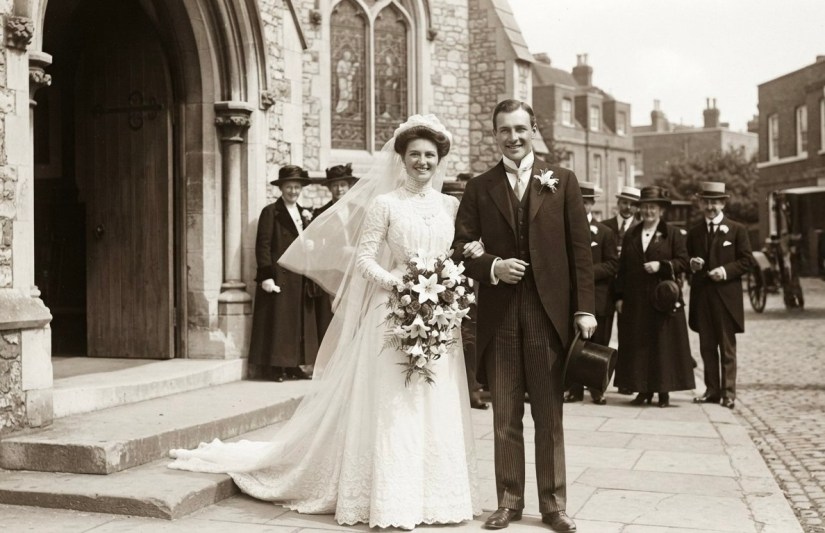
Image by Me & ChatGPT
Mary had been Mrs. Ashworth for precisely four days and still turned around when someone called her name, expecting to find Thomas’s mother behind her.
The landing stage was a black mass of umbrellas and hats and people who had come simply to look, and above them all the newest member of the Cunard family rose like a floating cathedral.
Thomas clutched their tickets. “Second class,” he had said, fairly bursting. “On the Mauretania. On her first crossing. Do you understand what that means?”
“It means you’ve spent your Uncle Herbert’s legacy on a boat.”
“A ship, Mary. And not just any ship. The fastest thing afloat. Turbines. Seventy thousand horsepower.” He said turbines the way other young men said the names of chorus girls.
She had thought him slightly ridiculous. She had also thought, watching the rain bead on the shoulders of his good overcoat, that she would quite like to be ridiculous alongside him for the next fifty years or so, and that this was probably what people meant by love.
She was sick by Queenstown. The fog came down off the Irish coast so thick the ship slowed to a crawl. Mary lay in their cabin with a basin and a damp cloth, wishing she had married a man who loved the railway. Thomas sat with her through the worst of it. He read aloud from a dreadful penny novel, doing all the voices, including a French countess whose accent at times sounded more like Merseyside.
“You’re very bad at this,” she told him weakly.
“I’m aware. Shall I stop?”
“Don’t you dare.”
1935
They were not the only ones aboard for the final run, but almost. A few officials, some newspapermen, a handful of old Cunard hands. One of the reporters, a bright-eyed young fellow from the Daily Sketch, found out about them within the hour.
“The maiden voyage? Honestly? On your honeymoon?”
“Honestly,” said Mary.
“And you’ve been married ever since?”
Thomas raised an eyebrow. “That’s generally how it works, young man.”
The reporter laughed and licked his pencil tip. “Any secret to it, then? Twenty-eight years?”
“Twenty-seven,” Mary said. “And eight months. Don’t round us up; we’ve earned every one of them.”
“Fair enough. But any secret?”
Mary and Thomas looked at each other, and something passed between them that the young man from the Sketch did not quite understand.
“No secret,” Thomas said. “We’ve had our share of choppy waters. You just don’t get off the ship.”
The Atlantic, November 1907
Their first quarrel was on the fourth day out, and it was about a waltz.
The seasickness had passed, the fog had lifted, and the Mauretania was tearing westward through a grey, heaving sea. There was music after dinner, and a tall, sandy-haired American from Philadelphia asked Mary to dance while Thomas was off somewhere mesmerized by an engineer explaining boiler pressure.
She danced with the American. Twice.
Thomas came back and stood by a pillar, face frozen over.
“I don’t see why you’re cross,” Mary said afterward on deck, which was a lie; she saw exactly why.
“I’m not cross.”
“You’re cross as a T.”
“I’m not…..” He stopped and pulled his collar up against the wind. “I left you alone to go and look at turbines …. on our honeymoon. That’s what I’m cross about. Not him.”
Which was so unexpected, and so honest, that she forgot entirely to be clever. She put her hand through his arm, and they stood at the rail watching the wake spill out white behind them in the dark. And at that moment, she couldn’t have loved him more.
1935
The Mauretania came up the east coast on the second day and swung in toward the mouth of the Tyne, where she’d been built. Thomas had heard there might be a crowd. He hadn’t expected this.
The banks were black with people. Shipyard men in their caps. Women with prams. Old fellows who must have built her nearly thirty years before, standing perfectly still with their hats over their hearts. Somewhere a band was playing Auld Lang Syne, and the ship’s whistle answered, deep and long, and the whole river seemed to shiver.
Mary found she was gripping the rail.
“Thomas. I didn’t think it would be like this.”
“Nor did I.” His voice sounded choked. “Silly, isn’t it. Crying over a lot of steel.”
“It isn’t a lot of steel,” she said. “Not to them, and not to us.”
He didn’t answer. He didn’t need to. She knew he was thinking what she was thinking: when Thomas left to fight in France, and the Mauretania herself had gone to war in dazzle paint, carrying troops and then the wounded. Mary had stood on the platform at Piccadilly with little Edward on her hip, and for two and a half years she had not known, from one week to the next, whether she was a wife or a widow.
He came home in 1918 with a limp and a silence that lasted the better part of a year. That was the choppiest water of all. There were nights she lay awake listening to him breathe and wondered whether the man who’d read the voice of the countess in a Merseyside accent had come back at all.
He had. It took time. It took a great deal of patience on both sides and one memorable row in the scullery that ended with a broken teapot and both of them laughing until they wept.
“Do you remember,” Thomas said, “when Edward was small and wouldn’t sleep, and you’d tell him stories about the big ship with four chimneys that carried Mummy and Daddy to America?”
“He thought we’d sailed to the moon.”
“I sometimes think we did.”
New York, 22 November 1907
They had come into New York harbor on a cold, clear morning, the city standing up out of the water like nothing either of them had imagined, and the tugs all tooting, and crowds on the piers, and the Statue of Liberty smaller than Mary had expected …. and greener.
“Well,” Thomas had said. “We’ve crossed the Atlantic.”
“We have.”
“On the finest ship in the world.”
“So you keep telling me!” she laughed.
He’d turned to her then, pink-nosed with cold, absurdly happy. “And we didn’t drown, and you only hated me for the first three days. I’d call that a promising start, Mrs. Ashworth.”
But she held his hand all the way down the gangway, and all of the next week in New York, and the long crossing home, and, more or less, ever since.
Rosyth, 4 July 1935
The ship came in to the Firth of Forth in the evening, her masts already cut down so she could pass beneath the great red cantilevers of the Forth Bridge. The small group of passengers gathered by the gangway with their bags. The young pressman from the Sketch shook their hands and wished them many happy returns of the day.
Thomas lingered on the deck after the others had gone ashore. He laid his palm flat on the rail, the way a man might lay a hand on an old horse’s neck.
“Thank you, old girl,” he said quietly. “You got us started.”
Mary waited. Then she took his arm.
“Come along, Mr. Ashworth,” she said. “We’ve a train to catch, and I’m not missing it on account of your sentiment.”
“Says the woman who brought the hat.”
“The hat,” Mary said, with tremendous dignity, “is a matter of principle.”
They went down the gangway together, slowly, his bad leg and her good sense, into the summer evening and whatever was left of the voyage.
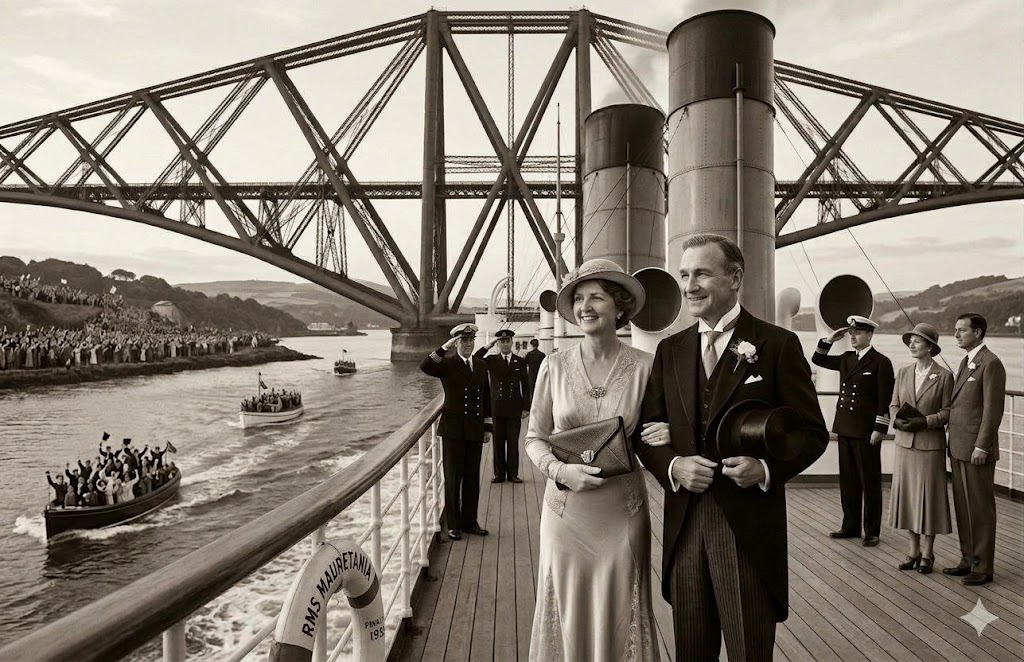
RMS Mauretania, Fort of Firth
Image by Me & ChatGPT
NAR©2026
This is a brief video of the final run of the RMS Mauretania, July 2, 1935
This is “For Me and My Gal” by The Stardust Voices
Everything on The Elephant’s Trunk was created by me, unless otherwise indicated, and may not be used without permission. Thanks for your consideration. NAR©2017-present.

