
Inspired by Max’s blog, ‘Old Steam Ships’ –
RMS Olympic: Old Reliable. Please be sure
to check out Max’s site for more information,
videos, and photos of RMS Olympic.
During WWI, RMS Olympic served as a troop ship, carrying thousands of soldiers across dangerous waters. This is a dramatized account of what happened early in the morning of May 12, 1918, as seen through the eyes of a young soldier in the US Army on his way to France and to battle.
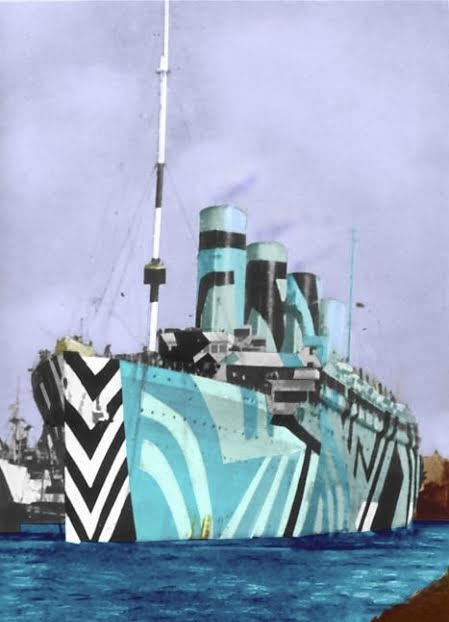
Private Thomas Webb of the 59th Infantry had learned to sleep through almost anything …. good thing, since arriving in France was still weeks away. He had not, however, learned to sleep through this.
It was not the collision that woke him. It was the guns.
The 6-inch deck guns of the RMS Olympic erupted before 4:00 AM, hammering the darkness with a violence that threw men from their bunks below deck. In the cramped berths where the 4th Division’s soldiers were packed, chaos erupted instantly. Someone shouted that they were under attack. Someone else swore they’d heard a torpedo. Nobody knew anything, and everybody was certain of everything.
Then came the shudder …. a deep groan that seemed to pass through the very bones of the ship, felt as much as heard. Seconds later, a grinding roar tore through the hull beneath their feet, metal against metal, prolonged and intense, as if the ship itself were being gutted from below.
Webb was certain, in that moment, that the Olympic was dying.
But all the training kicked in and held. Men reached for lifebelts with shaking hands, falling into practiced lines toward muster stations, boots slapping the steel decks in the dark. It was discipline, not calm, that moved them …. the same discipline that would carry them through the trenches soon enough. And then, strangely, a new fear crept in beside the first: the ship hadn’t slowed down. If anything, she was pulling harder, engines climbing toward full speed. She was not sinking; she was running.
Word passed in fragments through the passageways. Not a torpedo. Not an attack, not really …. more a kill. The Olympic had rammed a German U-boat and cut clean through it.
Those who reached the decks or found a porthole to press their faces against saw the proof written across the water in the grey half-light of dawn: a black slick spreading and shimmering, a churn of white foam where a submarine’s hull had been, and scattered wreckage bobbing in the ship’s wake. Among it, impossibly small shapes in the water …. German sailors clinging to whatever would float, watching the great ocean liner recede.
Olympic did not stop for them. Admiralty orders were absolute: a stationary ship in these waters was an invitation to every other U-boat prowling the Channel. So she left them behind for the American destroyer USS Davis to retrieve, and kept running toward Southampton.
For the soldiers of the 59th, relief came slower than fear had. It settled in over hours, then days, as the shock gave way to something closer to reverence. They easily could have become the victims of another accident of history, destined for a watery grave, but a British captain’s nerve had denied the sea its due.
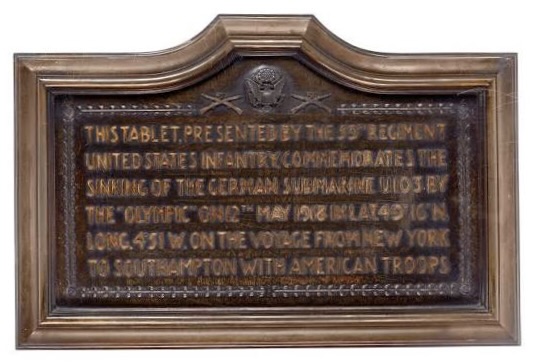
So when they reached port, the men did something no order required. They pooled their pay …. dollars meant for letters home, for small comforts …. and commissioned a bronze plaque, to be mounted in one of the ship’s grand lounges. Its words were simple, permanent, and grateful:
This tablet presented by the 59th Regiment United States Infantry commemorates the sinking of the German submarine U-103 by the Olympic on 12th May 1918… on the voyage from New York to Southampton with American troops.
They had sailed into war as passengers. They arrived as witnesses to a miracle, and made certain it would not be forgotten.
NAR©2026
Nancy’s Notes: Dazzle camouflage is a bold pattern of contrasting geometric shapes used mostly on warships in WWI and WWII. It does not blend a ship into the ocean, nor is it used for hiding. Rather, it uses striking lines and contrasting colors to break up the ship’s shape, making it difficult for enemy gunners to figure out the ship’s speed, how far away it is, and the direction it is moving.
This is “RMS Olympic – Pride of the White Star Line” by The Longest Johns
This is a clip from the 2022 movie “Operation Seawolf”
Everything on The Elephant’s Trunk was created by me, unless otherwise indicated, and may not be used without permission. Thanks for your consideration. NAR©2017-present.


That was fascinating, Nancy. I love the footnote, too. Hard to believe they figured out that paint job helps confuse the enemy!
LikeLike
I knew about the way they painted the ships, and why but I didn’t know the story of this collision. Thanks. This was fascinating.
LikeLiked by 1 person
Thanks, Dan. I’m totally enjoying this steam ship series and I’m pleased to know you are, too.
LikeLiked by 1 person
Now that’s some paint job! Can’t miss it, well, unless you are a submarine.
LikeLiked by 1 person
Haha! Quite true!
LikeLiked by 1 person
An incredibly descriptive piece, Nancy, thank you for sharing it with us. I’m pleased too that I crossed to Max’s site where I learned even more thanks to his pictures and video.
LikeLiked by 2 people
I’m so pleased you hopped over to Max’s site; those images are amazing, aren’t they? Thanks for your very kind comments, my friend. Most appreciated, as always. 😊
LikeLike
That must be a rush when you ram a submarine.
LikeLiked by 1 person
I imagine it must be. It’s exciting enough to get me to watch the movie!
LikeLiked by 1 person
Private Webb woken, the shudder of the ship, the fear it was dying, and then the realization: the Olympic wasn’t sinking, she was running. She’d rammed a German U-boat and cut clean through it. The soldiers could have been casualties of history, but a captain’s nerve saved them. And they pooled their pay to commission a bronze plaque so it would never be forgotten. That’s not just a war story, Nancy. That’s gratitude made permanent. 💙
/ Love & Hugs / Khadija 💕🤗
LikeLiked by 1 person
You’re absolutely right, Khadija! Thanks for your always kind and generous comments as well as your much-appreciated feedback. 🥰
LikeLiked by 1 person
Great write Nance – what a wonderful lady she was and so strong. I did pop over to read more about her on Max’s site it was lovely to see that a lot of her interior still lives on 🙌
LikeLiked by 2 people
Oh, I’m so glad you saw the gorgeous pix Max shared with us. Can you imagine being surrounded by so much luxury? Thanks for reading my story, Ange; I’m happy you enjoyed it. 😊
LikeLiked by 1 person
🩷
LikeLiked by 1 person
Wonderful post Nancy! I didn’t know about the tablet and thank goodness it was saved when she was scrapped. I love that Operation Seawolf video…if you shoot at her, you best hit her or you are toast. Because of the sinking of the Titanic, Olympic was refit and was probably the safest and most durable ocean liner out there. I LOVE that dazzle paint scheme.
My time machine ship would be this one. You know without a doubt you will arrive at your destination once you board her. Those big ocean liners were huge targets for the U-Boats…but she turned the tables on them. This post is worthy of the ship herself. As President Franklin Roosevelt said, Every Ship has a soul. She could have told a lot of stories.
She kept her crew safe…the story is incredible that a huge ocean liner could turn around and get a much smaller U-Boat. Thanks again Nancy. This showed the other side of her than just taking people back and forth on the Atlantic.
LikeLiked by 1 person
Guess which movie my husband and I will be watching today!
Your post and it’s companion posts allowed us to take a good look at Olympic’s elegant and luxurious accommodations. I’m so pleased parts of her were saved and incorporated in structures elsewhere; that magnificence truly needed to live on. Her beauty as an ocean liner was so well represented in your post, I knew I had to take a different approach. And what better way than to show her “military” side through the eyes of our US troops. As you may recall, I mentioned to you that my parents honeymooned in Bermuda in 1939; the beautiful ocean liner they were on had been painted battleship grey …. something my mother didn’t appreciate. I much prefer the dazzle camouflage which was something I was unaware of prior to this story.
Thanks for your wonderful comments; I especially appreciate what President Roosevelt said about ships having a soul. I have always felt that way and that was the impetus that got my series going in the first place. Every ship has a soul and a story to tell; I’m delighted to have the opportunity to bring those stories to life. 😊
LikeLiked by 1 person
I’m embarrassed to say I don’t know what movies are showing right now but…well, there is one I know of and I want to see. The End of Oak Street…time travel…I’m always into that.
Thank you. It was in the first batches of posts I worked on…I kept coming back to her as I found out more. I think you took the best possible route. She needs to be remembered for that as well. She brought home a lot of US and Canadian troops safe and sound. That is so cool that your parents took an ocean liner. I wonder which one it was? Sorry if I asked before…wow that was when the war was beginning. They kept the dazzle for a while…which I loved. You can’t hide one of those liners anyway…so might as well confuse them.
I didn’t know this but President Roosevelt loved ships and donated a model of the Rms Mauretania to the Smithsonian and it’s still on display. And I thank you for doing this. It helps people to know about these great ships.
LikeLiked by 1 person
Thanks again, Max. I never knew the name of my parent’s honeymoon ship but I can try to google it. They were married on Sept 3, 1939 in NYC and left for Bermuda a few days after, maybe the 7th. I know they went to see the Wizard of Oz before their honeymoon and saw the final live appearance by Judy Garland, which my search tells me was Sept 6. Their departure had to be after the 6th. Time to google!
LikeLiked by 1 person
Wow…they married on the exact day that Great Britain declared war on Germany…no wonder it was in that grey! Most ships were called back for war around that time…they got in just in time!
What a movie to see and to see Garland…I might look a little as well.
LikeLiked by 1 person
Cool! Now I’ve made you curious!
LikeLiked by 1 person
Yes you have! The ship was coming from New York right?
LikeLiked by 1 person
Yes, NY to Bermuda.
LikeLiked by 1 person
Maybe the SS Monarch of Bermuda (it was the Honeymoon Ship)… It wasn’t the Queen of Bermuda…that one got recalled into service at that time. They still have passenger lists for many of these. That part is incredible!
LikeLiked by 1 person
I found the same info. I’m going to search for my parent’s names (Vito & Concetta Schembre). It will be incredible if I can find them! Thanks, Max!
LikeLiked by 1 person
I love this stuff. I knew that Clara Bow went over seas and I found the ship she and her husband traveled on…it’s fun being detective on ships. If I find anything I will tell you.
LikeLiked by 1 person
On September 13…The Monarch made her final departure from Bermuda, bound for Brooklyn. She was then removed from regular passenger service and converted for wartime use. Still looking for the ship manifest…but that one is the most probable one…almost certain.
LikeLiked by 1 person
It has to be! I have the ship manifest …. all 108 pages! I haven’t had time to look through all the names. According to everything I was able to find, it has to be the Monarch.
LikeLike
I really loved this Sis an interesting read
They had some great strong ships , the White Star Line……. not all of them though were built that well 💜💜💜
LikeLiked by 1 person
Thanks so much, Sis. I hope you had a chance to check out the photos on Max’s site. They are breathtaking! 💜
LikeLike
Ansolutely 💜💜
LikeLiked by 1 person