You can read Part 4 HERE.
We stayed at the table for a long time after that.
The afternoon had gone quiet in the way late Saturday afternoons do, the week finally exhaling. Jeff refilled our cups without asking, which I was already starting to understand was just the way he moved through the world …. anticipating things without making a production of them. It was a small kindness, but it landed.
“Tell me about him,” he said.
I looked up. “My father?”
He nodded. Nothing in his face made the question feel like prying. It was just …. an open door. I could walk through it or not.
I walked through it.
“He was funny,” I said, which wasn’t what I’d expected to say first. “That’s the thing people never mention when someone dies. They say ‘he was kind’ or ‘he worked hard’ …. and he was, and he did …. but the first thing I think of is that he was funny. Dry. Precise. He’d say one thing at exactly the right moment and it would be so perfectly observed that you’d still be laughing ten minutes later.”
“He sounds like someone worth knowing,” he said.
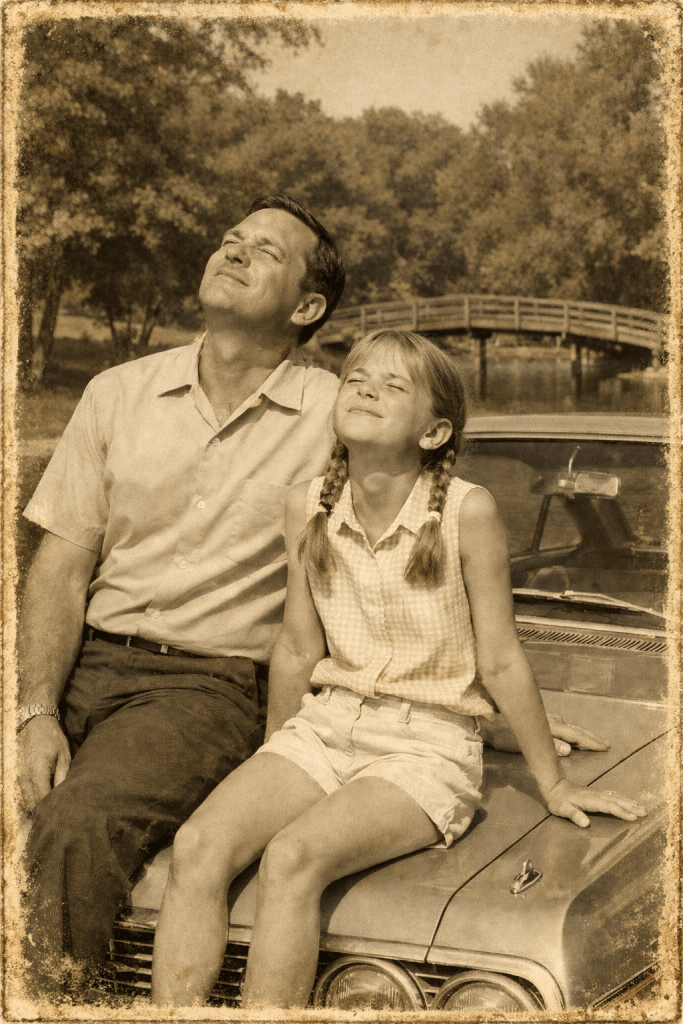
“He was.” I turned the photograph over in my hands, the one of the two of us on the hood of the car. “But there was another side to him. There always was.”
I set the photograph down and looked at it for a moment before I spoke again.
“He had depression. The serious kind, the kind that had a grip on him long before I was old enough to understand what I was seeing. There were good stretches …. sometimes long ones …. and then there were the other times. When he’d go somewhere inside himself that none of us could reach. My mother used to say he was tired, which was her way of not saying the true thing.” I paused. “I think she was trying to protect me. I think she was also a little frightened.”
Jeff was listening the way he listened …. completely, without preparing his response.
“When I got older I understood it better. Or I thought I did. But by then things between us had gotten …. complicated. I didn’t always know how to be around him when he was in one of his dark spells, and I think he knew that and it shamed him.” I smoothed the folded letter on the table. “He wrote about it. In here.” I passed the letter to Jeff and he read it aloud:
“I was not always easy to love, Becca, and I knew it.
There were days I couldn’t find my way out of the dark
no matter how hard I tried, and I watched you watching me
trying to figure out what you’d done wrong.
You hadn’t done anything wrong. I need you to know that.
The darkness was mine. It had nothing to do with you”.
“He was sick,” I said. “And then he was dying, which was a different kind of sick. By the time the cancer was diagnosed he’d already been living with depression for twenty years. I think in some ways the cancer was almost …. clarifying for him. He knew how much time he had, and he used it. He wrote letters. Dozens of them. Everything he hadn’t been able to say out loud.”
“Because saying it out loud was too hard?” Jeff asked.
I thought about that. “Because writing gave him time to find the words. He was better on paper than he was in person. Just …. more himself, somehow. Like the page steadied him.”
The kitchen had gone the color of warm honey. Outside, a car moved slowly down the quiet street and was gone.
“My mother found the box after he passed,” I said. “She put it away. I’m sure she never opened it …. it wasn’t addressed to her. And then she moved, and Helen Matthews ended up with it, and here we are.”
“Here we are,” Jeff said quietly.
I picked up the photograph again. The man and the small girl, the bright squinting sun. He looked so peaceful. He looked, in that moment, like someone who had no idea what was coming …. the dark years, the good years tangled up in them, the letters he would one day sit down to write to a daughter who wasn’t there to receive them in person.
“I was angry at him for a long time” I said. “For the distance the depression put between us. For dying before I figured out how to cross it.” I set the photograph down face-up on the table. “But reading what he wrote …. I think he was trying to cross it too, the whole time. He just didn’t always have the bridge.”
Jeff reached across the table and touched the back of my hand. Not a gesture that demanded anything …. just a point of contact, brief and steady, the way you’d press a hand to a wall in the dark to know where you were.
He took his hand back. I didn’t say anything. Neither did he.
But something had shifted, the way furniture shifts in a house that’s settling …. too quiet to hear, only felt.
NAR©2026
End of Part 5. You can read Part 4 HERE.
This is “The Bridge” by Elton John
Everything on The Elephant’s Trunk was created by me, unless otherwise indicated. Thank you for your consideration. NAR©2017-present.

 The Elephant's Trunk