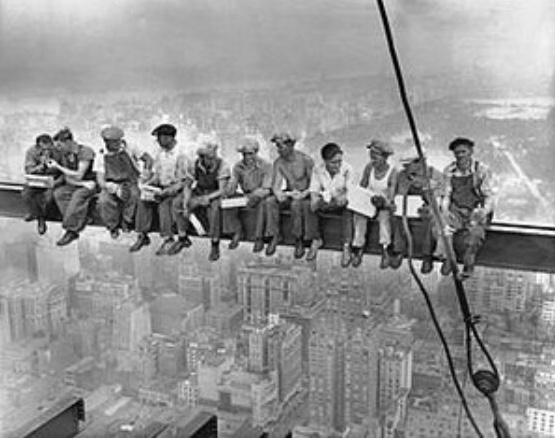
Francesco glanced down from his perch 60 stories above the streets of New York City; that translated into roughly 900 feet in the air. As he ate lunch, he talked casually to his companion, Giuseppe, who sat across from him on a ledge about four feet away. Francesco lit a Camel cigarette, tossed the box of matches to Giuseppe and both men lounged on their beds of steel. Francesco took a long drag on his cigarette, keeping his eyes open to maintain his balance on the 18-inch-wide metal plank. A whistle blew, its shrill notes informing the men that lunchtime was over.
Giuseppe pitched the matches back to Francesco. They rose to their feet, now old pros at this daily death-defying ballet they performed. When they first arrived in America, they learned very quickly that the jobs of police officers, firemen or train engineers were not meant for them; those positions were reserved for the Irish and English immigrants. The Italians and others who didn’t speak English were forced into manual labor – jobs in construction or sanitation where grunting and nodding were the main forms of communication. They took pride in their work, the resulting cathedrals and skyscrapers testaments to their skill and determination.
An errant gust of wind made its presence known; it swirled around the men’s feet and scooped up the wrappings from lunch, tossing the papers about before they slowly drifted out of sight. Both men held on to a nearby vertical beam, silently waiting until the wind stilled.
Looking below at the large wind flag, the men saw that it was white; it was safe to continue working. A yellow flag meant to exercise extreme caution while red indicated dangerous weather conditions. The crew worked through many different elements, but if a red flag was up, no one climbed the beams.
There were no harnesses to prevent a catastrophic fall, no safety nets should someone slip … nothing to protect the men, to save them. All they had to help them scale the beams were ropes dangling from above, good balance and guts.
Calmness restored, the men strapped on their tool belts containing welder’s gloves, hammers and tongs. A pulley system was used to hoist beams and buckets filled with iron rivets in white hot coals. Using their tongs, the men removed the rivets one by one from the coals, inserted them into holes in the beams and hammered them into place. After every hole was filled, the men climbed up to the next level and repeated the process.
When the end-of-work whistle blew, Giuseppe reached for the rope to begin the long, slow descent to solid ground. A slight misjudgment caused him to lose his footing and he slid off the beam like a marionette whose strings had been severed. Francesco yelled out in horror “No, Giuseppe, no!!” as he tried in vain to grab his friend’s arm. The crew watched in stunned disbelief as Giuseppe fell headlong to the sidewalk far below, his screams echoing throughout the canyon of steel.
Francesco slumped over, his head in his hands, silently weeping as a single mournful thought invaded his mind: he didn’t even know Giuseppe’s last name.
NAR © 2023
Please tune in today
for a very special
In The Groove.
https://rhythmsection.blog/

 The Elephant's Trunk
A great tribute to that crazy period of time when they worked under such unsafe and insane conditions. Well done.
LikeLiked by 1 person
Thanks so much, Bridgette! Being a Sicilian immigrant with no knowledge of the English language, my grandfather had no other option than to work construction and sanitation. It was a very tough way to make a living and some of his stories were difficult to hear.
LikeLiked by 1 person
A nice story, Nancy, as always ! Ending depends on the nature of topic. I have seen coal mines and I know how risky it is to work there.
LikeLiked by 1 person
All manual labor jobs are dangerous; not much happens when you’re sitting behind a desk except gaining weight!
My grandfather worked in both construction and sanitation. They were rough jobs. In the 1920s sanitation crews were often called out to help in emergency situations. I can remember hearing stories about boating accidents and my grandfather had to help pull bodies from the water. He would often have bad dreams.
Thanks so much for your comments, KK.
LikeLike
Well written story, Nancy.
I thought you might be interested in reading this article. https://en.wikipedia.org/wiki/Lunch_atop_a_Skyscraper
27 men died during the building of the Brooklyn Bridge, and 5 of the total 3400 during the construction of the Empire State Building. Incredible that more men died on the bridge than that tall building.
LikeLiked by 1 person
Thank you for that link, dear Misky; I will read it after responding to your comment. If I have to guess I would say drowning and/or “the bends” are key factors when working on, in or around water. My grandfather worked both sanitation and construction after WWI; he had many a horror story to tell, especially about bridge building and repair. Thanks for this great comment and your input, Misk.
LikeLike
Yeah … After I opened the link I realized I had read it already while doing research for the story. Still, it was an interesting read. Thanks for sending it, Misk.
Here’s a fun little vid I found about building the Brooklyn Bridge; I’m just gonna leave it right here for you (or anyone else) to check out. Thanks again, Misky!
LikeLiked by 1 person
You know why we need more storytelling like this one, Nancy?
Because nowadays everything has been reduced to statistics and percentages of GDP.
From “collateral damage” to ” workplace casualty” a sanitized terminology is desensitizing us.
I am not going to argue the necessity of Myth in our societies. My dear Joseph Campbell wrote everything there is to be said about that.
What I am going to say, Nancy, is that you and all the rest Storytellers and your stories are needed. More than you can perceive.
Thank you, cara🌹
PS: Isn’t it a good laugh when people think they have gained knowledge (of anything) by Googling and choosing the headlines that fit their narrative?
” I learned very early the difference between knowing the name of something and knowing something” Richard P. Feynman
LikeLiked by 1 person
What an awful term that is … “collateral damage”. When I hear those words I always wonder what happened to the sanctity of life. Have we totally lost our soul, our heart, our conscience? Honestly, Nick. Is there anything more important than that? I don’t think so. Certainly not questioning whether the photograph I used is real or a staged publicity photo! Who cares?
Mille grazie, caro amico! Your comments have made me profoundly happy and proud. Is this the greatest story I have ever written? Probably not … but it is one of the most “real”. If I can get one person to feel Francesco’s pain and horror watching Giuseppe fall to his death, then I have done a good job.
I appreciate you and your comments. Thanks so much for sharing your thoughts today! ❤︎
LikeLiked by 1 person
I don’t think I could do that kind of work today, with all of today’s health and safety precautions in place, let alone back then, Nancy. A good story highlighting the risks taken to earn a living. 🙂
LikeLiked by 1 person
My point exactly, Tom … and it is a good point. Thank you for mentioning it. This is a story highlighting the risks taken TO EARN A LIVING. Men put their lives on the line every day to feed their families. We can try to imagine what it was like but we will never truly know.
Thank you for sharing your thoughts today.
LikeLiked by 1 person
Great story. Kind of left me dumbstruck…
LikeLiked by 1 person
Thank you, John. Makes you wonder how many accidents like that actually happened.
LikeLike
More than they let on, I’m sure.
LikeLiked by 1 person
Would you believe I’ve written a similar story about similar working conditions? It was such a tragic time in our history. But we persevered. Excellent work, Nancy.
LikeLiked by 2 people
Thank you, Staci! Of course I would believe that and I’d love to read it! Those certainly were difficult times. Thanks so much for sharing your thoughts today.
LikeLiked by 1 person
Your flash story gutted me, how tragic. And how well written!
LikeLike
Oh, thank you, Vera. I can only imagine how many families were devastated by similar accidents over the years. I appreciate your comments.
LikeLiked by 1 person
Fascinating description of the process, and the risks of just one mis-step. And you put a name to it Giuseppe, to make this extra memorable! 💔
LikeLiked by 1 person
Everyone needs a name, especially the unfortunate ones! Thanks so much, Liz. I appreciate you sharing your thoughts today.
LikeLiked by 1 person
Wow, …love your writing style, drew me along with ease, ….plus the description of working conditions, and the forced acceptance at the time, …no Health & Safety precautions, …it’s a wonder anyone lived to tell the tale, …The ending. ..What can I say, …I’m already emotional from my writing earlier, so I’m filling up again, …✨👏✨
LikeLiked by 1 person
Thank you, Penn, for sharing your thoughts! This is a period in our history that fascinates me. Lately I have been trying to tie in some of my stories with my postings at The Rhythm Section; today I was able to do exactly that. Thanks again for your very gracious comments and compliments. I appreciate them greatly!
LikeLiked by 1 person
A pleasure, …a really true pleasure…. ✨
LikeLiked by 1 person
Such a tragic accident.
LikeLiked by 1 person
It is, Sadje. Sadly, I’m sure accidents like this happened quite frequently. Thanks for sharing your thoughts.
LikeLiked by 1 person
My pleasure
LikeLike
A realistic story, but the image featured is (unfortunately?) staged and a publicity photo.
LikeLiked by 1 person
Whether this photograph is real or not is none of my concern. It is an iconic photo with a great deal of history behind it. The biography of the photographer, Charles Ebbets, is most impressive.
I am a storyteller, not a historian. I chose this famous photo because it suited my story perfectly. That is the only basis for choosing any of my photos.
You are a first time commenter here; I believe I am being more than generous in even acknowledging your comment.
LikeLiked by 3 people
Your point being…?
LikeLiked by 1 person
When I look at the Charles Ebbets photograph of the iron workers taking lunch, my heart flutters. Only occasionally does the thought cross my mind that the photographer with his box camera had an equally precarious perch in order to get the photograph.
LikeLiked by 3 people
An excellent point, A. As you know, there are some people who believe these photos are staged. I suggest they do a little research on Charles Ebbets, then make a decision. Whatever one may think, this series of photos is iconic and represents the very real conditions at the time. Thanks for sharing your thoughts today.
LikeLiked by 2 people
The Danish cousin of a friend of mines father is in this photo. He never would reap any benefits from it’s fame. None of these men did. They were exploited no doubt. ROCK in Sweden
LikeLiked by 1 person
That is unfortunate. It is also a subject I know nothing about and cannot offer an educated comment or opinion.
LikeLiked by 1 person
Tough times perfectly captured
LikeLiked by 2 people
Thanks, Deb. A great comment about times back in that period.
LikeLiked by 1 person