The claustrophobia started gradually for four-year-old Phoebe.
She had climbed into the back of her father’s flatbed truck to investigate the crates of chickens ready for market. Phoebe went unnoticed as her father threw a tarp over the back and locked the tailgate. When her dad found her, she was curled up in a ball, crying pitifully.
Over time, Phoebe seemed to forget about the incident in the truck.
Years later Phoebe was accidentally locked in her bedroom closet when a gust of wind blew through the window and slammed the closet door closed. Her parents were out and her older siblings were watching television; her frantic cries for help went unnoticed. Exhausted, Phoebe fell asleep in the closet, her family unaware. Her mother found her the next morning, traumatized.
Incidents like that kept happening. Phoebe became obsessed with her surroundings and her parents sought professional help. After eight years in the hospital, Phoebe was declared “cured”.
She met Evan, a great guy, and they began dating. Life was good again for Phoebe. For her birthday, Evan and Phoebe planned to see her favorite band. She felt safe with Evan and was unafraid to ride public transportation.
The train was packed. During one stop, Evan was pushed out with a crowd of passengers; the doors closed before he could get back in. Phoebe panicked when the train started up. She lost it.
At the last stop, Phoebe was found in the corner – disheveled, mumbling, eyes wild in terror. She was finally noticed.
Known to everyone as Baby Mary, she was my dearest friend for three fleeting years, from age four to seven. Nearly seven decades later and I can still picture her heart-shaped face the color of warm caramel framed by waves of chocolate-brown hair, her wide eyes glistening shyly.
At the time my family occupied the corner house of a row of two-family homes on Eastchester Road in The Bronx. Baby Mary and her large family, the Romanos, shared one of those houses. She lived on the ground floor with her parents and maternal grandmother. Her father’s side of the family lived upstairs.
We were just three houses away – close enough for little girls to run giggling back and forth multiple times a day. We spent all our time together, busy with important little girl things.
The residents of Eastchester Road were immigrants who adhered devoutly to their Italian heritage and love of family. They were proud to be living in the United States and strove to become citizens; some passed the test, others didn’t. We delighted in celebrating all the traditional Italian holidays and festivities while embracing all the new and exciting American holidays.
The 4th of July was without a doubt the noisiest day of the year on our street. Some how the men managed to get their hands on firecrackers, sprinklers, cherry bombs, ash cans, rockets and fireworks. Baby Mary’s uncles always seemed to have the most. I remember her uncle Joe had a massive lead pipe with a diameter of at least 12″. He’d prop the pipe against the fence in their backyard so that it was angled and facing the sky. With the glee of a little boy he’d toss firecrackers, cherry bombs, etc., into the pipe and yell for everyone to cover their ears. The explosions were deafening and we’d all cheer. The best was when he’d toss fireworks down the pipe and they’d shoot out into the night sky, erupting in glorious colors. Baby Mary and I would sit together in the corner with our sprinklers taking it all in with eyes as wide as saucers.
I was fascinated by Baby Mary’s mother and grandmother. They did work from home, sewing little bows and pearls onto ladies’ panties. Their hands moved rapidly as they sat in their crowded living room watching soap operas and sewing. I rarely saw Baby Mary’s father; he worked in New Jersey in his cousin’s shoe repair shop and only came home on weekends.
At the age of five Baby Mary and I started kindergarten. Every morning my mother would walk us to school and pick us up in the afternoon. The best times were when she came to get us in her car. My mother was one of the few women in our neighborhood who had a driver’s license. We would gleefully hop into her Ford Fairlane 500, begging she take us to Carvel for ice cream. Sometimes we’d stop for gas and my mother would complain about the price being 30 cents a gallon, calling it highway robbery.
When it was time for us to go to first grade, my parents decided to send me to a private school. It was the first time I was going to be away from my dearest friend and we were heartbroken. We would run to meet each other after school and we played together as much as possible but it wasn’t the same. And our trips to Carvel were few and far between.
One day after school Baby Mary didn’t run to meet me. I looked up and down the street but she was nowhere in sight. My mother brought me inside and told me the saddest news I had ever heard: the Romanos moved away that day. She explained that they went to live in New Jersey where Baby Mary’s father worked. I cried for days and couldn’t understand why she had to leave; I felt so lonely. There was no one to tell my secrets to, play with my dolls or happily share ice cream. I had to see my dearest friend, even if it was for an occasional visit. I pleaded with my mother to drive me to New Jersey but she never did. There was always some reason why we couldn’t go. When a young couple moved into the Romano’s house it was as though Baby Mary never existed.
Years later I learned the truth: Baby Mary’s father was in The States illegally, a fugitive hiding from immigration authorities. He had committed a terrible crime before fleeing to America. He was apprehended in New Jersey and deported; the whole Romano family returned to Italy. I never saw or heard from Baby Mary again. I think of her often and wonder if she ever thinks of me, her dearest friend.
My father was the type of man who liked to have fun, even if the joke was on him. I’m guessing the picture shown above ⬆️ was taken at least 60 years ago but I remember it like it was yesterday. While my mother, sister and I were occupied with other things, Dad quietly went around the house collecting stuff – in this case a scarf, a yarmulke from a friend’s wedding and our family Bible. He then sat there not saying a word until one of us noticed and we all cracked up. I’m pretty sure at that point he started chanting which made the whole scenario even funnier. I showed this pic to my husband last night and even he cracked up. Yes, dad, your legend lives on!
Dad’s jokes weren’t always funny and he didn’t have much of a filter. I remember a family friend was complaining that she needed to lose weight. Dad told her she looked fine just the way she was which would have been totally acceptable if he’d left it at that but he had to add that she was “pleasingly plump“. Our friend was not happy with that description and huffed off, angry and embarrassed. Meanwhile dad couldn’t understand what he said that was so bad. He’d often do things without thinking them through like the times he’d invite people over for dinner and fail to tell my mother until a couple hours before their guests arrived, usually resulting in mom reacting sorta like this:
Mom was like Gina Lollobrigida on steroids!
She never really hit him over the head with a frying pan but she wanted to – lots of times. But that wouldn’t have stopped dad from telling the same old joke about the canary who ran out of gas or thinking he was entertaining countless waitresses by ordering an Al Pacino instead of a cappuccino which always resulted in an eye roll or a blank stare.
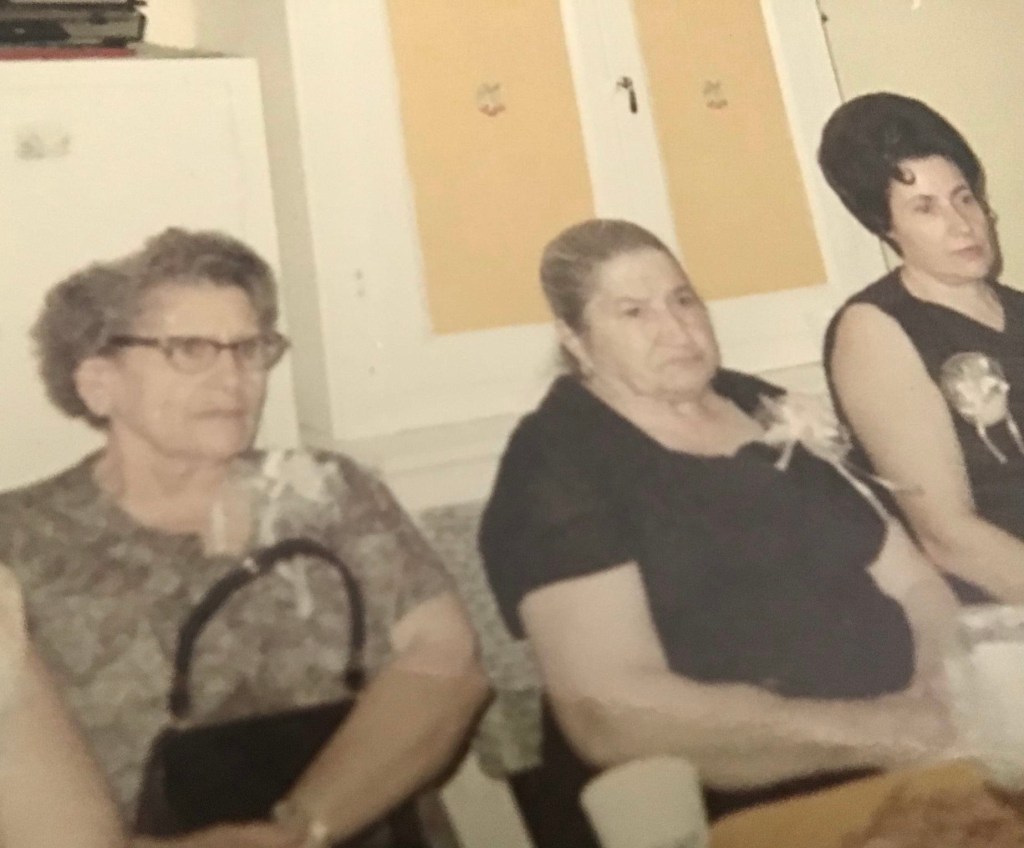
Speaking of blank stares, some of my relatives were hard nuts to crack and dad’s cornball jokes were definitely not appreciated. This was a particularly tough crowd; they look like they’re at a funeral instead of a bridal shower. ⬇️ And why is the woman on the left clutching her purse so tightly? She’s in my parent’s house; who’s gonna steal it? Probably fight or flight reaction due to Dad’s jokes.
L. to R. – My Aunt Cesaria, my grandmother (Dad’s mom), my Aunt Lena
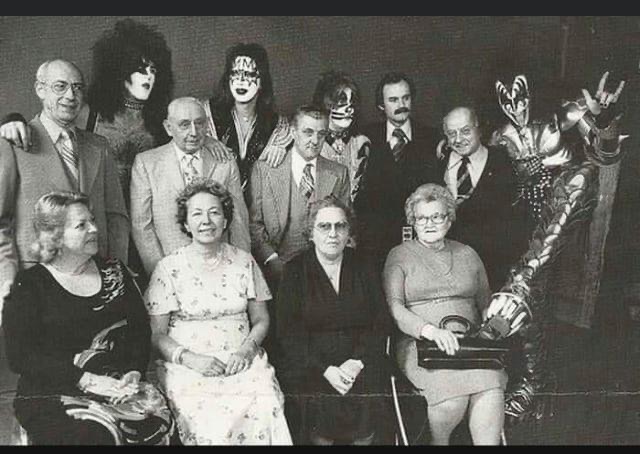
What’s with all the purse clutching? Must be a generational thing. Man, I would have loved to have been around when this next photo was taken. ⬇️ Talk about surreal! The parents look like very nice, normal people but totally confused and amused at the same time; I think those guys had that effect on all of us. (I was going to say they looked “Dazed and Confused” but that was done by a much better band – no offense.)
KISS with parents
My dad was a good guy who meant well and wouldn’t hurt a fly. He was all talk and no bite, like the time he convinced an art auctioneer that he was “connected“. The poor guy was wetting his pants and falling over himself to make sure ‘Don Vito‘ was satisfied and there would be no retaliation. Mom just rolled her eyes and called dad “stunad“.
Dad had a lousy head for figures so, naturally, he volunteered to be the church treasurer. He then proceeded to botch the books so terribly, the Elders of the church came to our house looking very serious and officious in their black suits and asked dad how he managed to screw up the numbers so badly. Even dad couldn’t figure out what he’d done wrong; he was totally flustered and way over his head. Everyone felt sorry for him but business is business and dad was officially removed him from his position.
Dad was an immigrant from Sicily who taught himself to speak, read and write English entirely on his own. And he barely had an accent. His biggest achievement in his eyes was being able to do the New York Times crossword puzzle in ink! Everyone loved my dad and it gave him so much pleasure to entertain his friends and spend time with his family.
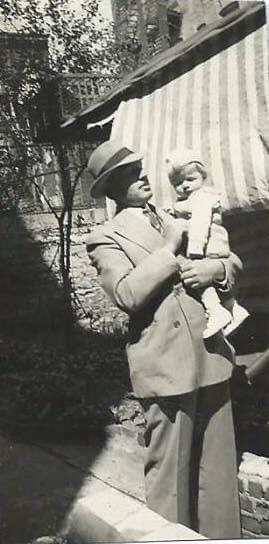
Times were tough, often heartbreaking. In 1943 mom and dad lost their first born and only son, the brother I never knew, when he was only 2-years-old. Baby Frank passed away on New Year’s Eve; my parent’s never celebrated or went out on New Year’s Eve ever again after that. Then my dad got drafted and was sent overseas. I can only imagine what Father’s Day must have been like that year. Talk about rough times!
Dad with Baby Frank, 1943
Now that I’m older and hopefully wiser, I regret being embarrassed in front of my friends when dad told a corny joke or sang a silly song. I wish I didn’t think of him as a clown or a buffoon; no one else saw him that way (except my sister) and he made a lot of people happy. I was young and stupid; I didn’t realize at the time everything he did was with good intentions.
My grown sons remember my dad, or ‘Papa’ as they called him, but I have four grandchildren who never knew him. I hope when my granddaughters start dating, my sons will wait up for them to come home from their dates, just as my dad did right up till the night before my wedding.
Me and Dad on my wedding day, June 10, 1972
When you’re young you think you have all the time in the world, then you start to realize the older you get the faster time goes by. There are plenty of things I wish I could go back and do over; I can’t. I just have to believe that my dad knew I loved him even when I didn’t show it. I hope he’s proud of the person I have become. I’m proud of my dad and I miss him. I know he’s listening so “Happy Father’s Day, dad! I love you!”
Dedicated to my father, Vito Schembre, July 14, 1915 – August 1, 1998
We’ve all heard the expression “Where there’s smoke there’s fire”. Well, if you were ever around the vicinity of Hawkins Street on City Island in The Bronx, particularly 50-something years ago, you’d agree that statement is true.
You see, back then John and Gertrude and their four kids lived on Hawkins Street in a cute little white saltbox house with blue trim – emphasis on little as are most houses on City Island, many of which were originally built of wood from dismantled ships. The main entrance to the house was a glass enclosed front porch maybe about five feet deep and 20 feet wide. Inside the porch was a door that led to the living room; for some reason no one ever used the front door. Everyone entered through a side door near the back of the house down the driveway – probably because it was easy to just get out of the car and walk a few feet to the side door.
That side door opened onto a long narrow unheated porch where Gertrude would store fruits and vegetables and other sundry food items. The porch ran almost the entire length of the house and opened directly into the kitchen. From there, heading toward the front of the house, you’d find the dining room, a small step up into the living room and the previously mentioned front porch. A staircase leading to the second floor was situated between the living room and dining room. Upstairs were two bedrooms and single bathroom for six people. One bedroom was John and Gertrude’s; the other was shared by their four kids. The three boys had the main area and their sister’s “room” was a small section off the boy’s room that was originally a closet. The only entry into the girl’s bedroom was through her brother’s room – certainly not much privacy. The house had no attic, basement or any other storage area.
To say the house was “cozy” is an understatement but they managed. It was a happy house and it served them well.
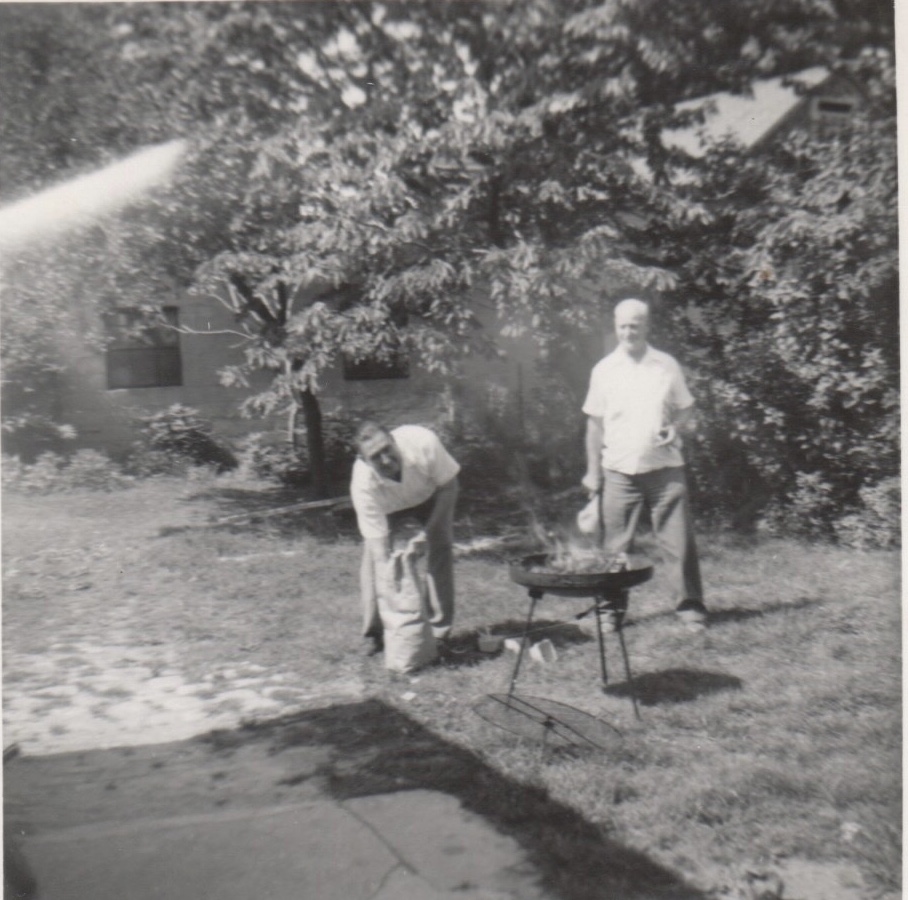
John worked for the New Haven Railroad at the Hunts Point Terminal Market, the largest wholesale produce market in the United States. One of the perks of John’s job was he got to bring home leftover fruit, vegetables and other items that got left behind or “fell off the trains” – a real bonus for a family of six living on one income. Whatever John brought home, Gertrude didn’t have to buy at the grocery store and could spend a bit more on meat and other staples. Gertrude knew how to stretch a dollar and once in a while the family would enjoy a nice steak. There was a cute little dog named Fluff who lived across the street. He’d come running whenever John lit the grill and waited patiently till the end of the meal for the steak bones. If there was one thing John really enjoyed it was getting a good fire going in the old grill.
Gertrude had a clothesline that ran from the back of the house across the yard to the opposite side where it was attached to a section of the wooden mast from the America’s Cup contender “Vanitie”. Hauled up at Jacob’s Shipyard on City Island, “Vanitie” had been dismantled and stripped of everything, even her bowsprit. Nothing remained but the hull and mast of the once beautiful sloop; how that section of the mast ended up in the backyard at 93 Hawkins Street was a mystery to the family but it sure was a conversation piece. Surrounding the mast were a number of cherry and fig trees and an assortment of bushes. Off to the side was an old shack which was barely standing.
One day John decided it would be an easy and enjoyable task for a fire-lover such as himself to get rid of the shack by burning it piece by piece on the grill instead of dismantling the whole thing and lugging all the pieces of wood and shingles to the junkyard. After all, he burned all the detritus in the garage – why not the shed?
The smell was terribly acrid and the amount of smoke was enough for neighbors to call the fire department several times until they finally realized it was just John burning pieces of the shack. Some men spent their spare time constructing additions to their houses; John incinerated dilapidated outbuildings of his house. Fire is mesmerizing and he was getting the job done, albeit in an unconventional manner.
Over the course of several months that old shack gradually disappeared. On the last day of the sacrifice by fire, John got a bit carried away and loaded up the grill with the last remaining pieces. Well, I think you can guess what happened next.
The flames grew higher and one spark leapt up and kissed Gertrude’s clothesline, setting it and all the drying laundry ablaze. The fire continued down to the end of the line, igniting the trees and a few surrounding bushes; somehow the old resolute mast miraculously escaped damage. Hearing Fluff barking his head off, Gertrude looked out the window to see John desperately trying to salvage what he could of the backyard. Billowing clouds of dark smoke filled the sky above Hawkins Street and beyond.
Gertrude ran to the phone to call the fire department; so did a dozen other people. Thank goodness they didn’t simply think “Oh, that’s just John at the grill again”. The fire trucks arrived in time to salvage what was left of the yard. The same, however, could not be said for John’s sorely wounded pride.
Fifty-plus years later and we’re still talking and laughing about my father-in-law John’s adventures at the grill.
While I may have exaggerated the facts a bit, there no denying that this story was truly written in loving memory of my father-in-law and mother-in-law John and Gertrude Richy, both taken from us much too soon. My affection for them could never be exaggerated. ❤️
The annual Burning Man Festival is traditionally held from the end of August through Labor Day which is why I chose this date to publish my story.






 The Elephant's Trunk